It is always a more difficult process to transition back into living aboard full time after a stretch of time in a larger space. We came down yesterday with our truck load of stuff and the inevitable compression back down into 33' is always stressful. When we go elsewhere to house-sit, it's the opposite: our relative paucity of stuff is released into a huge environment where it all flows out and is hardly noticeable. Here, it piles up quickly and all the habits of getting things packed and keeping them stowed have not yet kicked in so it is constantly cramped and untidy.
This year, just about the time we re-learn all those habits and things start to get ship-shape again, we're going to be off house-sitting again... the bad habits that come with living in huge spaces will only be reinforced.
At least yesterday was a pleasant spring day and we got to go for a walk and enjoy the benefits of being back in the marina. We have a fairly easy month ahead. We decided we did not ultimately have time to take any trips up to Canada in between now and our next house-sitting engagement, so we are just going to stick around Puget Sound. We might take some short trips to the South Sound, or to a weekend yacht club event or two, but otherwise we'll hang out at Shilshole until we go back up to Port Townsend in mid-June. We'll be back again in mid-August and have no idea at all what we'll do after that. August itself is pretty well booked up with events in Seattle or Idaho, so we won't be going anywhere then. After that, we're really up in the air. Gas prices being what they are, it's an open question whether or not my parents will need anyone to look after their place next winter. The RV is a thirsty beast! We almost certainly won't find a new boat by then, and there are some business opportunities that may be coming up for Mandy in the Seattle area anyway, so I guess the odds are that we will stick around here for fall and winter, at least. We may take some short trips but fall is not the time to be heading north.
I managed, eventually, to get the starter problem fixed with the truck. It turned out not to be the contacts at all, but the gear assembly, so I did end up replacing the whole thing. The new one was a little quirky at first but it seems to be functioning smoothly now. Next up: a vacuum leak (I suspect) that is messing with my idle speeds.
As far as the boat itself goes, it's in pretty good shape except for the head seal leak that needs fixing. The head is all cleared out and ready for me to get started, but I have not been eager to dive into it and it may be mandatory to wait for a day that is nice enough that I can have all the portholes and vents open before I start cracking it apart. Looking at the forecast, I am hard pressed to find anything of that sort coming up.
Showing posts with label systems. Show all posts
Showing posts with label systems. Show all posts
Tuesday, May 24, 2011

Sunday, April 17, 2011
Getting ready for summer
We had to go into town last week to see our accountant, and it was our first opportunity to catch up with friends and family there after a month of dog-sitting had pinned us down in Hadlock, so we turned it into a three day mini-trip. It also conveniently overlapped with a monthly yacht club meeting, which we have missed the last few of, so we were also able attend that.
It was the first time we had a chance to spend any significant amount of time on the boat for a few months, and I was a little worried about what I might find. I already knew there were a couple projects to be done. The leaky head has been on my radar since last fall, but before tackling that we needed to pump her out (as clean as possible, thank you!) so that was on the agenda this trip, and also some AC wiring needed to be replaced/reterminated after a melt-down earlier in the winter. What else might have happened in our absence was what I was most apprehensive over, however; boats left sitting on their own do not fare well during the winter months and I attribute our relative lack of troubles this past couple of years to a continuing presence aboard even during the off-season months.
Our trip to town did not start off well; we had a ten AM meeting with the accountant so we planned to catch the eight o'clock Kingston-Edmonds ferry, but when I got in the truck and turned the key, all I got was: click! My first impression was that the battery was out, but that didn't really make a lot of sense since it had only been a week since I had been anywhere with it, and it had started without any hesitation then. Sure enough, when I hooked the charger up to it, the only change was: click!click!click!click!click!click!click!click!click!click!
So, most likely the starter, not something I could do much about right then. Fortunately, my parents left their car here over the winter so we grabbed the keys for that and made the next ferry and got to our appointment on time. Just before we went in, I got a call from someone and had to make some notes; the pen I grabbed exploded while I was making them, and got all over my hands and notebook. So I looked really poorly prepared when we went in to go over our tax return. At least that part went well.
Afterward, traffic was terrible, the weather was miserable, and Mandy was hungry, a very bad combination. We had to get gas before going to a restaurant, and since the Costco gas station is right next to Home Depot, I had to buy my project supplies there too. Instead of just being able to pick the wiring you want off the shelves now, they have some big fancy motorized rack that only store employees can use to access the wire spools, so I was further delayed explaining what I needed and waiting for the Home Depot guy to figure out how to get it.
Eventually we got the girl some food, which was helpful, and then I dropped her off at a Starbucks to get some work done and stay out of my hair while I was working on the electrical system. It was, I think I have mentioned, cold and miserable, but while I was working on the AC system the whole thing had to be off, which meant no heat. So, I fumbled around with numb fingers stripping wire and crimping and re-attaching various connections. In some ways I got lucky: the main trunk from the shorepower connector had been melted right at the switch terminals, but it still had enough slack I could cut that away and re-terminate it with clean wire. The length of wire to the aft AC circuit was completely trashed, so I replaced it with some outdoor wiring, hopefully better suited to the harsh engine compartment environment it runs through. That was a pretty short run so I didn't have to do much to replace it. I was worried that it had damaged some of the other circuit cables, but fortunately it had not.
I pulled everything off the AC bus and cleaned and shined up the switch terminals. I suspect poor contact there led to a lot of the excess heat in the first place. In a perfect world, that panel would get replaced, but here I settled for cleaning and sanding them up. The subject might get revisited next winter if we need to run heaters frequently again.
That work took me all afternoon, curled up like a contortionist over the engine, and I was cold and sore and in a spectacularly negative mood by the time I was done.
The next day, though, things were a little better. The wiring all worked, and despite running the hot water heater, battery charger, and a space heater all night long, it wasn't warm at all. Then I fired the engine up for the first time in six months and despite having forgotten to switch the battery over to the start bank, it turned over and caught on the first attempt. No water in the fuel, and I only had to top up the transmission fluid slightly. The transmission itself was no worse than ever. The much-patched muffler spat out a load of rusty water, but didn't leak at all. It's getting replaced this summer anyway, but it was still gratifying that all the patches held over the winter. Perhaps the rust has reinforced them.
So we went over and pumped out the holding tank in the rain, and flushed it through as many times as I could convince Mandy to do so. We pulled the access plate on the toilet and it was as clean inside as I have ever seen it. I'm going to let it set for a while to dry out, then pull it apart to hopefully find and fix the leaky seal.
There were no other leaks anywhere; the forward part of the bilge was bone dry. There was a little water in the after part but no more than was there last time I looked at it, months ago.
While I was mucking around with all those systems, Mandy cleaned up the galley and icebox and took off the rails that hold the ice box lid up, which were beginning to fracture and need to be repaired. We'll have to do something similar with the larger and more fragile rails that support the nav desk at some point, so fixing these up will be a good trial run.
So things are fairly good on the boat front, even as we continue to look for a replacement. As far as the truck goes, I found a rebuild kit online for about ten bucks, so that is on the way and I should have time to pull the starter and make sure that's the problem before the kit shows up. And as for the rest of our summer, we have a slightly better picture of what it's going to look like than we did a month ago. Some friends of my parent's are planning to go to Las Vegas for July and August, and they asked if we could watch their cats while they are away. Since we didn't really have anything else planned, we said sure. So we are going to be house-sitting for most of the summer, too. If there is time in between, we might duck up to Princess Louisa Inlet, which we still have not seen after passing by it five or six times. Otherwise, we finally got official liveaboard status at the marina, so we can hang around at the dock as long as we want or take short trips around the Sound without respect to watching our dock-time to stay under the allowed limit.
It's probably not going to be much of a sailing summer, but that's okay; we'll be able to get more work done, and hopefully afford a better boat when we find one!
It was the first time we had a chance to spend any significant amount of time on the boat for a few months, and I was a little worried about what I might find. I already knew there were a couple projects to be done. The leaky head has been on my radar since last fall, but before tackling that we needed to pump her out (as clean as possible, thank you!) so that was on the agenda this trip, and also some AC wiring needed to be replaced/reterminated after a melt-down earlier in the winter. What else might have happened in our absence was what I was most apprehensive over, however; boats left sitting on their own do not fare well during the winter months and I attribute our relative lack of troubles this past couple of years to a continuing presence aboard even during the off-season months.
Our trip to town did not start off well; we had a ten AM meeting with the accountant so we planned to catch the eight o'clock Kingston-Edmonds ferry, but when I got in the truck and turned the key, all I got was: click! My first impression was that the battery was out, but that didn't really make a lot of sense since it had only been a week since I had been anywhere with it, and it had started without any hesitation then. Sure enough, when I hooked the charger up to it, the only change was: click!click!click!click!click!click!click!click!click!click!
So, most likely the starter, not something I could do much about right then. Fortunately, my parents left their car here over the winter so we grabbed the keys for that and made the next ferry and got to our appointment on time. Just before we went in, I got a call from someone and had to make some notes; the pen I grabbed exploded while I was making them, and got all over my hands and notebook. So I looked really poorly prepared when we went in to go over our tax return. At least that part went well.
Afterward, traffic was terrible, the weather was miserable, and Mandy was hungry, a very bad combination. We had to get gas before going to a restaurant, and since the Costco gas station is right next to Home Depot, I had to buy my project supplies there too. Instead of just being able to pick the wiring you want off the shelves now, they have some big fancy motorized rack that only store employees can use to access the wire spools, so I was further delayed explaining what I needed and waiting for the Home Depot guy to figure out how to get it.
Eventually we got the girl some food, which was helpful, and then I dropped her off at a Starbucks to get some work done and stay out of my hair while I was working on the electrical system. It was, I think I have mentioned, cold and miserable, but while I was working on the AC system the whole thing had to be off, which meant no heat. So, I fumbled around with numb fingers stripping wire and crimping and re-attaching various connections. In some ways I got lucky: the main trunk from the shorepower connector had been melted right at the switch terminals, but it still had enough slack I could cut that away and re-terminate it with clean wire. The length of wire to the aft AC circuit was completely trashed, so I replaced it with some outdoor wiring, hopefully better suited to the harsh engine compartment environment it runs through. That was a pretty short run so I didn't have to do much to replace it. I was worried that it had damaged some of the other circuit cables, but fortunately it had not.
I pulled everything off the AC bus and cleaned and shined up the switch terminals. I suspect poor contact there led to a lot of the excess heat in the first place. In a perfect world, that panel would get replaced, but here I settled for cleaning and sanding them up. The subject might get revisited next winter if we need to run heaters frequently again.
That work took me all afternoon, curled up like a contortionist over the engine, and I was cold and sore and in a spectacularly negative mood by the time I was done.
The next day, though, things were a little better. The wiring all worked, and despite running the hot water heater, battery charger, and a space heater all night long, it wasn't warm at all. Then I fired the engine up for the first time in six months and despite having forgotten to switch the battery over to the start bank, it turned over and caught on the first attempt. No water in the fuel, and I only had to top up the transmission fluid slightly. The transmission itself was no worse than ever. The much-patched muffler spat out a load of rusty water, but didn't leak at all. It's getting replaced this summer anyway, but it was still gratifying that all the patches held over the winter. Perhaps the rust has reinforced them.
So we went over and pumped out the holding tank in the rain, and flushed it through as many times as I could convince Mandy to do so. We pulled the access plate on the toilet and it was as clean inside as I have ever seen it. I'm going to let it set for a while to dry out, then pull it apart to hopefully find and fix the leaky seal.
There were no other leaks anywhere; the forward part of the bilge was bone dry. There was a little water in the after part but no more than was there last time I looked at it, months ago.
While I was mucking around with all those systems, Mandy cleaned up the galley and icebox and took off the rails that hold the ice box lid up, which were beginning to fracture and need to be repaired. We'll have to do something similar with the larger and more fragile rails that support the nav desk at some point, so fixing these up will be a good trial run.
So things are fairly good on the boat front, even as we continue to look for a replacement. As far as the truck goes, I found a rebuild kit online for about ten bucks, so that is on the way and I should have time to pull the starter and make sure that's the problem before the kit shows up. And as for the rest of our summer, we have a slightly better picture of what it's going to look like than we did a month ago. Some friends of my parent's are planning to go to Las Vegas for July and August, and they asked if we could watch their cats while they are away. Since we didn't really have anything else planned, we said sure. So we are going to be house-sitting for most of the summer, too. If there is time in between, we might duck up to Princess Louisa Inlet, which we still have not seen after passing by it five or six times. Otherwise, we finally got official liveaboard status at the marina, so we can hang around at the dock as long as we want or take short trips around the Sound without respect to watching our dock-time to stay under the allowed limit.
It's probably not going to be much of a sailing summer, but that's okay; we'll be able to get more work done, and hopefully afford a better boat when we find one!
Wednesday, August 11, 2010
It's always windy in Nanaimo

I may have mentioned that before. At any rate, it's perfect for us right now, because we decided to test our spare anchor here on this stop, a two-day layover before heading for Howe Sound and Vancouver later in the week. Nothing to work out your hook like strong and shifty winds, which is what was forecast here. Well, not so strong, 15 knots, but when you throw in all the people going unreasonably fast and throwing wakes around the harbor, all the bouncing should give it a good work out.
We've had this Bruce anchor for a couple of years but the only time we used it, it didn't work so well and the conditions were poor, and our regular Danforth type has been rock solid, so there was no incentive. But I keep reading that Danforths don't reset when the direction of pull changes (as in a wind direction shift), and while that has never been our experience (we've been in some dandy wind shifts, and it's stayed right where we put it), there have been a few times when I have hauled it up and the long handles at the head of it have gotten twisted up in the anchor rode, effectively shortening our scope and putting pull on the anchor at an unpredictable angle. While this has never resulted in any problems, it makes me nervous, and the Bruce should avoid that issue, so we are giving it a try. It's smaller than I would like for a primary anchor, but as long as the winds are moderate (as forecast) it should be fine... and if higher winds are forecast, they are usually from a single direction, in which case the Danforth will serve perfectly well as it has in the past.
We're in Nanaimo again after a two-day jaunt down from Grace Harbour in Desolation Sound. Grace Harbour was a nice little spot, watched over by the inukshuk in the picture above. The inukshuk may be familiar to you, as it is to us, from this past winter's Vancouver Olympics, where it was part of the logo. We don't know if this one was here before that or if it's always been, but thought it was a neat touch.
We waited at Grace Harbour through a brief patch of unseasonable southeasterly winds, and hitched a lift on the northwesterlies as they returned to blow us down the west side of Texada Island. The largest island in the straight of Georgia, Texada doesn't see much traffic on the west side since the strait it forms together with the mainland on the east (Malaspina) is well-protected and an easy and direct route to points north. We've come down the west side in the open strait before and it's always a bit of a ride; this time, we stopped on Lasqueti Island, Texada's little brother, to spend a night in False Bay. It's definitely off the beaten path. We saw few other boats out on the water, and only a handful anchored inside. Lasqueti looks like an interesting little place but we were too tired to explore.
The next day we kept going, heading for Nanaimo even though it's on the wrong side of the Strait from our next destination because it was the best anchorage available within twenty-five miles without backtracking. This turns our jump to Howe Sound from one long and arduous day into two pretty easy ones.
That's about all I have to report. The weather has gotten back to very nice again after the spat of rain that came with the southeasterlies, and we're just waiting here for a day of variable winds to blow themselves out and get back into steady northwest winds so we have a fast and predictable ride across to Howe Sound tomorrow.
Saturday, July 17, 2010
A short time-out
We had intended to head north from Nanaimo pretty much directly (with overnight anchorages, obviously) to Desolation Sound, but events have conspired to keep us in Garden Bay for at least another day.
First, yesterday was a pretty rough crossing, at least in part. The Strait of Georgia lived up to its reputation for roughness as we cut across the western half... short, sharp chop and gusty winds had us burying our nose in saltwater and Mandy heaving over the side despite medicative precautions. We were both exhausted by the end of the day and in no mood to get up and press on immediately this morning.
Second, this morning was Saturday; yesterday, then, was Friday, and that makes it a weekend, and we inadvertently put ourselves on the same track as hordes of vacationers from Vancouver and Nanaimo, who showed up shortly after we did and turned the bay into a big parking lot. A lot of these folks have the same general plan that we do, which is to overnight here and head on to Desolation Sound... that means they'll be at anchorages between here and there today, and up there through the weekend. If we wait a day, we should be able to find relatively open places as we work our way north along behind them.
Third, I noticed the bilge pump coming on more frequently than usual yesterday after we started the engine, and when I opened the engine compartment for inspection, my suspicions were confirmed... the muffler had sprung a leak again. I pulled it this morning to repair it, and sure enough, there was a new hole, adjacent, of course, to the part already fixed. I laid some liquid metal into it and will let it cure today; hopefully it will be okay tomorrow. I suspect that I botched the job... the liquid metal filler stuff sets up much faster than I expected and I didn't get it laid into the hole as deeply as I was thinking. But there's no sense in putting more in if that layer won't hold, so I will just have to put it all back together and see if it blows again. If so, I'll get an opportunity to do it right, although I'm not looking forward to it. The weather is too nice to be all jammed up in the lazarette messing with hose clamps.
Anyway, we wanted to take a crack at it while we are still only a day's sail away from major ports like Nanaimo or Vancouver, which could still fix us up if I really botched things.
Finally, our anniversary is tomorrow, and Mandy wanted a nice night out, and this is probably the last place anything of that sort will be easily possible. So, she'll have it a night early, assuming we can get in at the Garden Bay Hotel, which is reputed to have an excellent spread.
First, yesterday was a pretty rough crossing, at least in part. The Strait of Georgia lived up to its reputation for roughness as we cut across the western half... short, sharp chop and gusty winds had us burying our nose in saltwater and Mandy heaving over the side despite medicative precautions. We were both exhausted by the end of the day and in no mood to get up and press on immediately this morning.
Second, this morning was Saturday; yesterday, then, was Friday, and that makes it a weekend, and we inadvertently put ourselves on the same track as hordes of vacationers from Vancouver and Nanaimo, who showed up shortly after we did and turned the bay into a big parking lot. A lot of these folks have the same general plan that we do, which is to overnight here and head on to Desolation Sound... that means they'll be at anchorages between here and there today, and up there through the weekend. If we wait a day, we should be able to find relatively open places as we work our way north along behind them.
Third, I noticed the bilge pump coming on more frequently than usual yesterday after we started the engine, and when I opened the engine compartment for inspection, my suspicions were confirmed... the muffler had sprung a leak again. I pulled it this morning to repair it, and sure enough, there was a new hole, adjacent, of course, to the part already fixed. I laid some liquid metal into it and will let it cure today; hopefully it will be okay tomorrow. I suspect that I botched the job... the liquid metal filler stuff sets up much faster than I expected and I didn't get it laid into the hole as deeply as I was thinking. But there's no sense in putting more in if that layer won't hold, so I will just have to put it all back together and see if it blows again. If so, I'll get an opportunity to do it right, although I'm not looking forward to it. The weather is too nice to be all jammed up in the lazarette messing with hose clamps.
Anyway, we wanted to take a crack at it while we are still only a day's sail away from major ports like Nanaimo or Vancouver, which could still fix us up if I really botched things.
Finally, our anniversary is tomorrow, and Mandy wanted a nice night out, and this is probably the last place anything of that sort will be easily possible. So, she'll have it a night early, assuming we can get in at the Garden Bay Hotel, which is reputed to have an excellent spread.
Tuesday, July 13, 2010
So significant, I forgot to mention it
For some reason, our radar, which has been missing in action for nearly a year now, started working again yesterday morning when we turned on our instruments departing Telegraph Harbour. No reason that I could see for the change... we didn't bump anything, hadn't been rattled around at all at that point, none of the connections were changed at all from the day before. But it lit up consistently and seemed to be working fine all day long.
I don't trust it, of course. The whole thing points to some loose connection somewhere in the radome, and if it slipped back into place, it could slip out again just as easily. I checked everything I had access to during the haul-out this year and everything appeared snug, so whatever is wrong is buried pretty deeply in the radome and would need a technician's attention. The problem with that, of course, is that it's crazy expensive to get anyone to look at the damn things, and when the problem is intermittent, you can bet that the time they happen to look at it will be the time it happens to be working fine.
We'll see how long it lasts... I have been resigned to having to purchase a new radome before any significant trips in the future, but if this holds out through the foggy season here in late summer, I may hang on to it for a while. No guarantee that a new radome would be any more reliable, after all... this one is practically new as it is (although, of course, just out of warranty).
I don't trust it, of course. The whole thing points to some loose connection somewhere in the radome, and if it slipped back into place, it could slip out again just as easily. I checked everything I had access to during the haul-out this year and everything appeared snug, so whatever is wrong is buried pretty deeply in the radome and would need a technician's attention. The problem with that, of course, is that it's crazy expensive to get anyone to look at the damn things, and when the problem is intermittent, you can bet that the time they happen to look at it will be the time it happens to be working fine.
We'll see how long it lasts... I have been resigned to having to purchase a new radome before any significant trips in the future, but if this holds out through the foggy season here in late summer, I may hang on to it for a while. No guarantee that a new radome would be any more reliable, after all... this one is practically new as it is (although, of course, just out of warranty).
Saturday, July 10, 2010
The gentle thunder of electricity
So I mentioned that our solar panel was doing nicely keeping up with our boat battery needs, all of which are low-draw DC devices, but when it comes to getting work done, we rely on our computers... AC power required. I've never seen the point of using inverters to go from DC to AC for that purpose except in emergencies or if there is a surplus of power otherwise being generated by the system beyond what the battery bank or other draws require. It's just too inefficient to convert DC to AC, and when you are already operating in a low-margin system, that twenty percent or so loss can make it flat-out unsustainable.
Our laptops all run on DC current, and for the small Eee PC I use, it was easy enough to find a DC power adapter that plugs into it directly to use instead of the manufacturer's wall wart. I can charge it off the house battery system, with the engine or solar panel easily keeping up with the low draw it has. I've had more trouble finding direct DC chargers for our larger Apple laptops, though. There isn't quite the ecosystem of equipment providers as there are with PC laptops, and the chargers I have found all seem of dubious quality. The systems also draw quite a bit more than the Eee... enough that even with the solar panel at maximum efficiency, it wouldn't keep up with our working needs, to say nothing of our occasional entertainment uses.
Our alternative to date had been extra battery packs and intervals spent in marinas charging them up, then carefully shepherding them while we are out away from civilization. This year, though, we expected to spend a lot more time out, and didn't relish paying for marinas so frequently or having to dash back to civilization, so I broke down and brought my little Yamaha 1KW generator aboard.
We're not big generator fans, a stance borne of too many evenings/early mornings sitting in anchorages next to powerboats with big gensets and no compunctions about using them at odd hours. They're noisy and smelly, and we didn't really want to be the ones to inflict such disruption on our neighbors.
The Yamaha has a "quiet" mode it can use with low-draw applications, which keeps it down near fifty decibels, which I am told is conversation level. With it out roaring away in the cockpit, it seems a lot louder than any conversations I regularly have. But I hope that the combination of putting it down in the cockpit below the bench level and running it in quiet mode keeps it from being too obtrusive. It has a twelve hour runtime on one tank of gas (about half a gallon) but we'll only use it a couple hours at a time. And, if I have my way, we'll only do it when we're in an anchorage alone, or as today, we're far out on the periphery of a very large, already quite noisy harbor like Ganges. If our neighbors can hear us at all over the roar of floatplanes coming in every five minutes or runabouts screaming past, I would be very surprised.
So far it's working pretty well. I think that Mandy, with her noise-canceling headphones one, is getting the better part of the deal, though.
Our laptops all run on DC current, and for the small Eee PC I use, it was easy enough to find a DC power adapter that plugs into it directly to use instead of the manufacturer's wall wart. I can charge it off the house battery system, with the engine or solar panel easily keeping up with the low draw it has. I've had more trouble finding direct DC chargers for our larger Apple laptops, though. There isn't quite the ecosystem of equipment providers as there are with PC laptops, and the chargers I have found all seem of dubious quality. The systems also draw quite a bit more than the Eee... enough that even with the solar panel at maximum efficiency, it wouldn't keep up with our working needs, to say nothing of our occasional entertainment uses.
Our alternative to date had been extra battery packs and intervals spent in marinas charging them up, then carefully shepherding them while we are out away from civilization. This year, though, we expected to spend a lot more time out, and didn't relish paying for marinas so frequently or having to dash back to civilization, so I broke down and brought my little Yamaha 1KW generator aboard.
We're not big generator fans, a stance borne of too many evenings/early mornings sitting in anchorages next to powerboats with big gensets and no compunctions about using them at odd hours. They're noisy and smelly, and we didn't really want to be the ones to inflict such disruption on our neighbors.
The Yamaha has a "quiet" mode it can use with low-draw applications, which keeps it down near fifty decibels, which I am told is conversation level. With it out roaring away in the cockpit, it seems a lot louder than any conversations I regularly have. But I hope that the combination of putting it down in the cockpit below the bench level and running it in quiet mode keeps it from being too obtrusive. It has a twelve hour runtime on one tank of gas (about half a gallon) but we'll only use it a couple hours at a time. And, if I have my way, we'll only do it when we're in an anchorage alone, or as today, we're far out on the periphery of a very large, already quite noisy harbor like Ganges. If our neighbors can hear us at all over the roar of floatplanes coming in every five minutes or runabouts screaming past, I would be very surprised.
So far it's working pretty well. I think that Mandy, with her noise-canceling headphones one, is getting the better part of the deal, though.
Thursday, June 24, 2010
Muffler repair
We're one step closer to having a less leaky boat after Maxx and I pulled out and patched up the muffler. It was much less onerous than I had imagined it might be, although the state of the muffler as a whole is not particularly encouraging.
I began to suspect the muffler, or at least some part of the exhaust system, was leaking when I noticed on our last trip up to Port Townsend that we were taking on more water while under power than under sail. The water was clearly coming in from the stern, since I could see it dripping down near the prop shaft (itself which, since I could see it, and see no water coming in there, was a likely suspect early eliminated), but my only known problem back there at the time was the rudder shaft, which should leak the same amount regardless of the means of propulsion (it's true that the hull squats more in the water, increasing the pressure and therefore the leak rate, the faster we go, but the amount of squat for 5 knots under power is the same as 5 knots under sail, more or less).
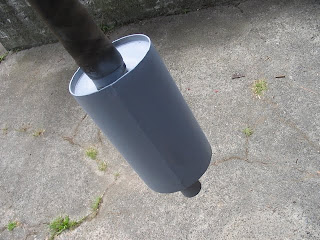
So, since it was associated with the engine somehow, and I could see the entire intake side of the engine cooling system, I deduced there was a leak in the muffler. This seemed like bad news, because you can't even see the muffler in its normal installation; it is tucked away beneath the fuel tank, and even with a mirror and flashlight cannot be inspected in place. It's that light grey thing at the end of the black exhaust hose in the picture there.
Fortunately, it proved to be easy to remove. We un-clamped the hose forward from the exhaust mixing elbow off the engine, pulled the muffler out by the house from behind the fuel tank (an area relatively easily accessed from the starboard cockpit locker) and then freed it from the rest of the discharge hose.
Sure enough, there was a hole. Assuming this would be the case, and knowing that a new muffler or a full-on repair wasn't in the budget this year, I had purchased some muffler repair tape in preparation. Unfortunately, the tape assumes a hole somewhere in the body of the muffler where it can be securely wrapped; this was a hole in the join between the body and the end.
Fortunately, Maxx owns a wire-feed welder, and even more fortunately, this welder is stored in our friend Torrey's garage, which is just up the road here in Ballard. We zipped over there and after a lot of cursing and four or five tries, Maxx got it back to watertight status. For good measure, we gave the thing a coat of engine paint to help ward off further corrosion. The metal is thin and pitted, so it's a temporary solution, but it should hold up for the rest of this year, at least. I haven't been able to try it under pressure yet; there was still a puddle back there and since I can't watch the muffler itself, I wouldn't be able to tell if water draining forward was coming freshly out of it or just from what is already there. After it dries out a bit I'll be able to test it.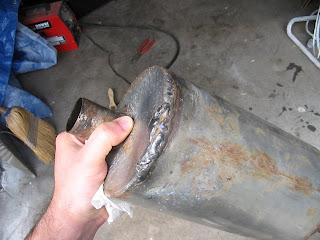
We had also planned to pull the rudder packing nut and check the packing on that again, since it was dripping coming back from the haul-out, but when we checked on the post, it was bone dry. I was not under the impression that flax needed to "take up" as they say with wooden vessels, but I'm firmly in the "if it ain't broke, don't fix it" camp so if it isn't leaking now, I'm not going to tear it apart and risk introducing a leak again. It could be that it's simply dry while we're stationary because there isn't any pressure (see above regarding "squat") but it could also be that it simply took some time to take up and squeeze in tight enough against the shaft to keep the water out. I'll find out for sure next time we get under way.
I began to suspect the muffler, or at least some part of the exhaust system, was leaking when I noticed on our last trip up to Port Townsend that we were taking on more water while under power than under sail. The water was clearly coming in from the stern, since I could see it dripping down near the prop shaft (itself which, since I could see it, and see no water coming in there, was a likely suspect early eliminated), but my only known problem back there at the time was the rudder shaft, which should leak the same amount regardless of the means of propulsion (it's true that the hull squats more in the water, increasing the pressure and therefore the leak rate, the faster we go, but the amount of squat for 5 knots under power is the same as 5 knots under sail, more or less).

So, since it was associated with the engine somehow, and I could see the entire intake side of the engine cooling system, I deduced there was a leak in the muffler. This seemed like bad news, because you can't even see the muffler in its normal installation; it is tucked away beneath the fuel tank, and even with a mirror and flashlight cannot be inspected in place. It's that light grey thing at the end of the black exhaust hose in the picture there.
Fortunately, it proved to be easy to remove. We un-clamped the hose forward from the exhaust mixing elbow off the engine, pulled the muffler out by the house from behind the fuel tank (an area relatively easily accessed from the starboard cockpit locker) and then freed it from the rest of the discharge hose.
Sure enough, there was a hole. Assuming this would be the case, and knowing that a new muffler or a full-on repair wasn't in the budget this year, I had purchased some muffler repair tape in preparation. Unfortunately, the tape assumes a hole somewhere in the body of the muffler where it can be securely wrapped; this was a hole in the join between the body and the end.

Fortunately, Maxx owns a wire-feed welder, and even more fortunately, this welder is stored in our friend Torrey's garage, which is just up the road here in Ballard. We zipped over there and after a lot of cursing and four or five tries, Maxx got it back to watertight status. For good measure, we gave the thing a coat of engine paint to help ward off further corrosion. The metal is thin and pitted, so it's a temporary solution, but it should hold up for the rest of this year, at least. I haven't been able to try it under pressure yet; there was still a puddle back there and since I can't watch the muffler itself, I wouldn't be able to tell if water draining forward was coming freshly out of it or just from what is already there. After it dries out a bit I'll be able to test it.


We had also planned to pull the rudder packing nut and check the packing on that again, since it was dripping coming back from the haul-out, but when we checked on the post, it was bone dry. I was not under the impression that flax needed to "take up" as they say with wooden vessels, but I'm firmly in the "if it ain't broke, don't fix it" camp so if it isn't leaking now, I'm not going to tear it apart and risk introducing a leak again. It could be that it's simply dry while we're stationary because there isn't any pressure (see above regarding "squat") but it could also be that it simply took some time to take up and squeeze in tight enough against the shaft to keep the water out. I'll find out for sure next time we get under way.
Friday, June 18, 2010
The faucet that kicked my a**
 In the past few years, I've thought of myself as not a bad plumber. Maybe not a good plumber, but not a bad one. Give me some barbed fittings, plastic flexible hose, and a few clamps and I could hold my own. In the five years we've had the boat I've replaced much of the existing hose, the head sink, and added a hot water heater. So, when the galley faucet started dripping last week, I offered to take on the project, and Scott happily agreed that it was a good idea.
I was actually glad the galley faucet finally created a reason to be replaced. It had a high spout, which is nice, but it also only barely reached over the sink. That's an odd flaw, since the one of the main jobs of a faucet is to direct water eventually down a drain. Every time (yes EVERY time) something was washed in that sink, as much water went behind the sink as in the sink.
I started in the same place I started when the head faucet needed replacing, the aisles of Home Depot. However, the great HD did not offer a suitable replacement. I went as far as to buy a regular bathroom faucet and bring it to the boat (since normal kitchen sink faucets don't use the 4"oc water supply posts). The new faucet looked odd and was quickly returned to Home Depot. I was thrilled to find an equally priced bar faucet from Overstock.com, and it arrived a short three days later. I opened the box, pleased.
As soon as I began the project, I remembered all the irritation of replacing the head faucet about four years ago. Nothing on this boat is accessible, especially the backs of sinks. I finally resorted to cutting the head faucet off with a hacksaw.
The galley faucet was equally unwilling release the adapter that connects a house faucet to boat flexible hose as the head faucet had been. We have better tools now, so this faucet got cut free with a Dremel. This would have been faster than the hacksaw, except the Dremel needs to be recharged frequently and does not have the oomph to cut through the upper sides of two supply lines (the only side we could reach) in a single charging. Still it was easier, as well as apparent that the evening project was now going to be a 2-day project.
Once the old faucet was off, the actual tightness of the undersides of the galley faucet became known. There is about a 2" space between the sink and the backside of the cabinet beneath the supply line posts coming down from the faucet. The adapters need to be screwed onto the posts, but there is no way to get a tool in there for assistance. So, by lack of any other option, it was merely hand tightened (by my weak hands). Not to mention that I thought I'd be smart and have the hose already attached to the adapter so I wouldn't need to mess with trying to tighten the hose clamps in the tiny space... except that the space is too tiny for the hose to spin around with the hose clamps already in place. So the clamps had to be loosened and pulled out of the way.
After hand tightening the adapter to the faucet-side supply lines as much as possible, the hose clamps were slid back up and tightened as much as possible with assistance from multiple different sized screwdrivers. Diverse curses and groans of varying pitches and amplification and a few cuts and band aids later, I re-pressurized the system, not actually confident that it would not leak. And leak it did. Cranking my head around, flashlight in sore hands, I could see the water coming from above the adapter.
Again, the adapter couldn't be tightened while the hose clamps were in place. So, off with the clamps, and while I was at it, off with the hose as well. No sense having that in my way. I mustered all the strength I could to get the cold water adapter off and replaced the Teflon tape, and screwed it back on again. The hot water I couldn't get back off, my arms and hands apparently having lost strength since connecting it hours earlier.
The next steps: Put the hoses back on, get the clamps back in place, turn the water back on, and try to identify where the drips are still coming from. Happily, it seemed the new drips came from above the hose, but not above the adapter. My additional cranking on it did some good, somehow. I hoped that tightening the two sets of clamps, screws opposite each other, may fix the drips. Except it didn't. Both hot and cold still let out a drip every few seconds. I've heard that over-tightening hose clamps can also cause a drip, since it can open up a gap near the flat screw area. But, given how difficult it was to get a screwdriver into the space, too tight seemed unlikely.
About 6 hours after starting that morning, I cried uncle. My arms hurt. My hands had been jammed by the screwdriver more times that I know. I called Scott back to the boat, saying I'd done my best, but the faucet had kicked my ass.
 Being diplomatic, he tried to convince me that not all of my time that day had been a waste. I still can't see how that can be true, since the first thing he did was completely remove the entire thing and start anew. The best I can think I did was supply him with an actual example of how it would all look when it was put together again.
It was time for me to teach, and he had the project to himself. By the time I was finished, so was he, looking nearly as beaten back as I felt. But he'd gotten closer to the goal of a new faucet that does not drip below the sink. Closer to a non-dripping faucet connection isn't an acceptable final outcome, and it seems drips slowly continued to fall. With everything quite wet by this time though, it was hard to tell what was new water and what was old.
We put everything back under the sink, since there is no place to put that stuff while we wait for everything to dry. I made dinner, and afterward laughed at the habits I saw had been in place for containing the water in the sink during the process. At least the new faucet does what it is intended to do. It turns on; it turns off; it releases water over the cavity of the sink and not along the perimeter of it. That's something!
Tonight, or maybe tomorrow, we'll take everything out again for a close inspection of possible drips.
Scott has taken a more philosophical reflection of the day in his Late Entry post, The Rules. After reading it, I thought back to the day I replaced the head faucet. No, it wasn't a day. It was three, possibly four days. I'd cursed, I'd probably cried, I'd asked for help, and it was eventually in place. And for all the years since I've just used it, happy that it existed, forgetting the trouble that got it there.
Hopefully this new chrome will bring me as much worry-free use. And all shiny and new, it sure is pretty!
~Mandy
Saturday, June 5, 2010
Haulin'
This year's haul-out has come and gone remarkably quickly considering we did it over three days instead of our usual thirty-hour turnaround. Still, I didn't feel like I had time enough to post anything, or even to take any pictures, although looking back I can't see what might have been so urgent. Yesterday, the day we splashed, for instance, I spent several hours simply sitting around waiting for paint to dry after everything else was all done. We even went back in the water early, a boon to the always professional, always fun yard workers at the Port Townsend Boat Yard... it being Friday, an early splash time on the last scheduled boat of the day, which we were, means an early weekend!
I had so much spare time because I wasn't sure what sort of shape the keel might be in after a close encounter with a rock in Montague Harbour earlier this year. Based on previous experience, it felt like it might have done a fair piece of damage, gouged some lead out, perhaps even damaged the hull above. So I booked a day in the middle, anticipating some real work banging it all back into shape.
During the actual hauling out, I am still on board the boat (yes, it's a pretty strange feeling when you're standing on deck and 7 tons of boat starts to take off like a helicopter) and so when the underside comes clear of the water for inspection, I can't see a thing. So all I could do was watch everyone else watching it and to try to judge from the looks of horror exactly how bad it might be. There were no obvious gasps or cries as it came out, but there was an ominous hush among the spectators which I took to bode ill.
When I stepped off and looked for myself, though, I got a pleasant surprise... some paint and epoxy had come off at the bottom of the fin, but there was hardly any lead damage, and it was all confined to a patch about four inches at the trailing edge of the keel. Why the trailing edge? We were in forward when we hit... I assume that most of the trouble came from getting off again. Conventional wisdom, in fact, is that once you are hard aground, it's better to stay there and refloat on the tide than to try to get a pull off. Our luck with that technique hasn't been so great, though, so I am fine with the decision we made to get yanked off quickly rather than waiting around.
Anyway, it took very little epoxy and fairing to get the keel back in shape, and most of it was done by the end of the first day. That day was a little windy to be painting, anyway; my friend Maxx and I had sailed up making hull speed on only a little scrap of unfurled jib, and all those powerful winds continued to hammer right into the yard after we arrived.
The next day was calmer and sunnier and dry enough for me to get 1.5 coats of paint on; I did a double-thickness with extra coppery paint near the waterline, where most of our fouling problems are. That said, the existing bottom job looked pretty damn good considering it had been in the water three years: the sprayers took off most of the crud, and the only barnacles were on the prop shaft and at the bottom of the rudder. The prop shaft zinc was missing, too... not sure at what point that might have come off but there was corrosion and pitting on the prop and strut, which isn't good. This year, in addition to putting a fresh zinc on, we put on a couple coats of a zinc spray paint which is supposed to help protect against both growth and corrosion.
While I painted, my stepfather did most of the epoxy and fairing work, my mother waxed and polished, and Maxx and Mandy worked on the other big project on the schedule: repacking the rudder stuffing. On and off, that took the better part of the first two days, but Maxx also found time to clean and paint the engine (at least, such parts of the engine that can be reached without taking it out entirely) and Mandy waxed and buffed the hull above the waterline. Some gouges and scratches in the gelcoat at the bow also got fixed up.
Everything ended up looking very nice and clean when all was said and done. I had two major disappointments, though. One, the radar, which had been acting up for more than a year and finally quit completely last summer, remains out of commission despite a rather lengthy trip up the mast to check the circuits and re-seat connectors and such. Whatever is wrong with it, it's more complicated than I can figure out, which likely makes it expensive to fix. Two, the rudder, despite being repacked, still leaks. I will have to tear that back apart in the water, possibly weighting the bow to raise the shaft above the waterline. I have some idea what might have gone wrong there, but won't be able to look at it for a couple weeks.
We also think that the muffler is leaking now; we make a lot of water underway, and I can see that the prop shaft is not leaking, but what is coming out comes out from near the front of the muffler. It's impossible to see the muffler itself, which is wedged in under the fuel tank, but it will probably have to come out for further examination at some point soon.
We basically came out of it having checked everything I wanted to check, but with only about half of it actually successfully addressed. Nonetheless, I feel better about it all than I probably should with that poor a track record, simply because the worst that might have come up, a major keel repair job, never materialized, and that was enough a relief to make up for the other disappointments.
Monday, May 31, 2010
Boat Week
Although we've been back aboard full time for almost a month now, we've been so busy working and catching up with friends in town that we've done little more than basic cleaning and tidying with the boat. That is all changing this week, which I will call "Boat Week."
Boat Week kicked off yesterday as I cleaned the decks (somewhat pointlessly, in view of the fact they are going into a grimy, messy boatyard in two days) and Mandy cleaned and de-stained most of the hull. I also checked over the engine, which looks a little rough but fired right up and ran well, and we motored over to the fuel dock to pump out our holding tank and fuel up. As usual, I was surprised by how little fuel we had used since the last fill up--about ten gallons. I was even more surprised at the price; almost sixty bucks. We've been watching gas prices on land drop these past few weeks, but apparently the marina kept a Memorial Day premium price or something. Marine diesel should be cheaper yet as you don't pay the "road tax" on it, but next time it looks like it's going to be cheaper to take our fuel jugs up to Safeway and lug them back.
Apart from that, the who evolution went well, and we are all ready to head north to Port Townsend Tuesday afternoon for our haul-out. The weather is just about the worst possible combination; Tuesday should have southerlies, but they are supposed to be "light" which for all practical purposes means no sailing, since you quickly outsail the wind when going the same direction in that situation. Wednesday and Thursday, days when we hope to be painting, promise to kick it up a notch, with southerlies to twenty-five knots... great for sailing, terrible for painting. Particularly because the yard in Port Townsend is moderately well protected to the north, but wide open to the south... those winds will whip across the bay and tear right into us. I have some tarps I can rig as a sort of wind/rain screen (oh, did I forget to mention it's supposed to pour rain as well? yeah) but I don't know if that will be sufficient.
Actually, as I check it this morning, the forecast has moderated somewhat, leaving Thursday not quite so terrible, but the fact remains that it's not going to suddenly break out in sunshine and chirping birds... one way or another it's going to be pretty grim outside.
We've got some barnacle scraping to do. We've never had that problem before, being primarily in fresh water in the past, so it will be interesting to see how easily, or not, they come off the bottom of this thing. Our paint sands off quite easily but I don't know how deeply they dig in.
I also am beginning to think that we have another leak toward the stern, in addition to the rudder post (which I already knew needed to be re-packed); I'm thinking we have some holes in the muffler. It's impossible to say for sure, because the muffler is wedged in beneath the fuel tank and I can only see one end of it. There is certainly water dripping out from beneath it at a fair flow while the engine is on (perhaps a drip a second) but you can't tell if it's coming from the muffler itself or somewhere further aft. If we have time, I'll want to yank it out and see if it can be patched up or welded. It doesn't absolutely have to be done while we're out of the water, though; it's below the waterline but there is no water in it unless the engine is running.
Ditto with cleaning and painting the engine. I would like to do it while I have extra hands around, most of who are more patient and methodical than myself, but it could happen another time if need be.
The keel is going to be the great unknown. I can't see a thing from above the water so I have no idea how dinged up it may be. The cool temperatures are not going to help with any work that needs to be done on it; epoxy and paint both dry slower when it's cold, and it's going to be pretty cold. My hope is that, one, it's repairable, and two, it's repairable inside our time frame... if we miss our splash time scheduled with the lift, we could get stuck. The yard is busy this time of year. Last time we were there, we were next to a guy who had missed his splash date and wound up having to sit there, paying yard fees, for an extra two weeks before they could schedule him back into the water. Of course, if the repair is that complicated, yard fees will probably be the least expensive part of it.
Anyway, rain and all I am excited to get out for the trip up and back. It's been rough, even with the terrible weather, just sitting here watching all the other Memorial Day boat traffic going in and out. We'll still have the terrible weather, but should have the Sound pretty much to ourselves for the trip.
Sunday, February 7, 2010
Drip..... Drip..... goes the rudder shaft
Which represents success, or partial success, at least, in the saga of the mystery leak in the stern section.
The folks at HunterOwners.com came through once again, providing better pictures, diagrams, instructions, and tool recommendations than I came up with anywhere else on the Internet. Turns out that everyone hates that fiberglass rudder support shelf... you can't see what you are doing, and you can barely feel it when you are squeezed in back there with one hand.
At any rate, they filled me in on exactly how the system works. The top nut is the packing nut; it is actually larger than it appears, extending up the post further than one can see, so that it has room to contain the packing material that is pressed against the shaft to seal it. You rotate it counter-clockwise, looking down, to loosen it up (if one were re-packing it, all the way up, when one would then futilely attempt to pick out the old packing with a toothpick or something and force the new flax into the gland), and clockwise to tighten it. The bottom nut is the locking nut, and rotates the opposite direction to secure the packing nut once you have it tight.
The folks in the forum recommended something called spoonbill vicegrips for the job, and from the picture they provided, those would have been about perfect. Unfortunately, when I got into town last night, I couldn't find any. I settle for a massive crescent wrench (which turned out to still be too small) and a large pair of channel lock pliers. In the event, only the channel locks were of any use, and they were damned awkward, as I had to try to use one hand to both keep them clamped tightly and to try to turn the nut. Toward the end as it got tight, that was very difficult indeed.
I first backed the locking nut off quite a way. As noted before, both were only hand-tight, so that wasn't difficult. I then tightened the packing nut down by hand as far as it would go, then went at it with the channel locks. A half hour later, I had it what seemed to be reasonably tight, and reduced the influx of water to a series of occasional drips only. I crossed my fingers and tightened up the locking nut against it, hoping that the rotation wouldn't loosen it, since I had nothing to hold it with, and for whatever reason my luck held and the two locked together tightly with no apparent backing of the packing nut. I went up and tried the helm, and the rudder still turned freely, so it isn't too tight. And hopefully, the bilge will start to dry out a bit.
I went and took a well-earned shower (it's super-grimy back in that space; I found loose nuts, washers, random bits of wood and plastic, and a tube of solder that all must have fallen in back there over the years) and now I am off to gorge myself at Dave's annual Superbowl party while I cheer the Saints on toward victory.
Tuesday, February 2, 2010
Drip drip drip goes the rudder shaft
So, just to get it out of the way, we did go to the boat show, and I was pretty severely unimpressed. Very few boats (very, very few sailboats) to look at, morose salesmen who looked as if their next step might be off the edge of the dock seeking the comfort of a watery grave, and nothing particularly new or interesting to hold our attention. I very much regret having bought tickets for two days, as both turned out to basically be a waste of time and money (well, except I got a cool light-up yo-yo from the Greater Victoria Harbour Authority booth).
So anyway, I put Mandy on a bus for Hadlock this morning and got down to the business of preparing the boat for the trip to Canada next week. If that doesn't sound like a lot of time to prepare to you, well, it doesn't to me either.
But it was sunny out today, and warm, and reasonably dry, and things went pretty well. I cranked the engine over and it started up on the first shot and ran solidly despite some really cruddy fuel coming in to the separator. I changed the primary fuel filter, and we'll fuel up before we head out, which should dilute the remaining crud and hopefully filter it all out. I checked and topped off the transmission fluid, and checked the transmission itself... it shifted smoothly in and out of forward and reverse. I lubed the steering gear and the transmission cable, and stowed our spare mainsail in some unused space under the helm lazarette.
The oil change went smoothly, too, and without much mess. Since everything was going so well, I decided to take a crack at tightening up the leaking rudder post, and that's where I hit a wall.
Apparently the thing seals with two very large (2"? I can't really see them) counter-rotating nuts atop the shaft. They are, however, right beneath a fiberglass shelf which apparently provides support for the entire rudder assembly, so they are the very devil to get at. This all happens, I should mention, at that point in the hull where it is sweeping up toward the transom, so the closer one gets, the more squeezed one becomes.
Anyway, I didn't have a wrench large enough to get on the nuts, let alone two, and if I had two, and they were big enough, I doubt I could fit them both into the space at the same time, and if by some miracle of modern industry all that could happen, I don't think I could spare enough arms to turn them.
This wasn't what I had expected to find at all. I had done some research when I first discovered the leak and the few references I could find to my model of boat talked only about a single packing nut; or maybe the whole assembly is referred to as the "packing nut" even though there are two components. I found someone discussing another model of boat talking about holding the top nut in place and rotating the bottom to tighten, which I suppose is basically what I would try anyway... but it's the sort of thing (hole in boat) where I would like to have a little confirmation before I go messing with it.
I would take a picture but it's dark out now and I don't have my flash camera with me. Anyway, I'm posting the question to HunterOwners.com and there is probably someone there who can clear me up on the matter, hopefully before I am back next weekend to finish all this up.
As far as finishing goes, the big thing I would like to have done is radar troubleshooting. I am pretty much resigned to having to send Mandy up to look at it again. She can't lift me, and even if she could, I'm really the only one who can operate the controls on the console to test it adequately (and safely) with someone up there. Bizarrely, it's easier to talk her through tracing wiring connections and measuring impedance and voltage values than the display console controls. Either way, I am pretty well resigned to the thing still not working, which is bad considering much of the trip will be happening at night and quite possibly in marginal visibility.
Fueling up and pumping out are really the only other things, and assuming the engine doesn't quit on us, that should all be done next weekend.
Thursday, January 7, 2010
A long shot

A primary challenge during our housesitting gig has been getting reliable Internet access. We hadn't wanted to pay for phone service, cable is not an option at this remote location, and satellite is too expensive. Cellular is both expensive and slow. Yet both of us have jobs that require regular and somewhat speedy Internet access. Fortunately, due to the location right on the water in Port Hadlock, another option presented itself: five miles north, visible across the water, is the Port Townsend Boat Haven, a marina served by the same wireless provider as our slip at Shilshole in Seattle, BroadbandXpress. Although it's a bit further away, it has the virtue of being a solution that has already been paid for.
We picked up an annual subscription last year before we left on our trip, since BBX has hot spots all up and down the Pacific Northwest coast. We could use them in most of the marinas and ports we hoped to visit, and although the service is somewhat limited and definitely not customer-oriented (they refuse to provide support for any equipment other than their own, which is over-priced and under-performing), it's about as good as things get in the marine environment.
Our standard on-board setup for receiving the wifi signal is good up to a mile and has connected at up to three miles, but the basic 8dbi omni-directional antenna and 500mw signal booster wasn't going to cut it across 5.25 miles of open water. Although the straight, open shot was a blessing in that it was absent any foliage or terrain that might block the signal, it was far enough that the dreaded Fresnel zone could be partially obstructed by the bulge of the curvature of the Earth. Moreover, a directional antenna that could be pointed directly at our desired access point was necessary so that other, closer but unrelated signals would not swamp it out.
I settled on a 24dbi grid antenna, which would allow a very tight beam to be directed at the marina hotspots.

We mounted it on a plain old galvanized pipe planted in the ground near one corner of the house, putting it up high enough to eliminate the Fresnel problem but close enough to reduce the cable run into the house.
To power it, we initially used the same Alfa 500mw booster we had on the boat, but it got to be a pain to drag it back and forth, and the ability to tweak the signal for the distance involved was limited, so we picked up and installed an Ubiquiti Bullet2. The Bullet is better designed for such distant connections, with more configuration options and the ability to tweak for the best possible connection. That said, it hasn't actually improved our speed much... we get by with a average .16Mbps which is about what you might get with an old ISDN type connection. Still, it beats the alternatives and it has been very stable and averages lower ping times than our connection in Seattle!
The problem we have is that we control only one end of the link. The BBX folks claim to support connections out to three miles but they probably are simply relying on the normal maximum capabilities of their equipment. Really getting good connections at anything over a mile requires some timing alterations in the signals. We can, and have, made those changes on our end (which means that our upstream bandwidth, what we can send out to the Internet, is roughly double the downstream bandwidth--pretty much the opposite of most connections!) but BBX has no incentive to tune their systems for the distance when most of their customers are actually in the marina itself.

Still, it's proven an adequate solution, if not ideal. I'm impressed with the Bullet, which works across a standard network cable with power injected into it at the house side. It's very compact, has a good management console, and a signal meter built into the device (which itself mounts very near the antenna) which makes it very easy to align the dish with the highest signal strength. It works on a 12V system, which means it could be fairly easy to integrate into a boat-based system in the future without the added complication and waste of power inversion (which most other such dedicated devices require). And because it is a stand-alone device, it doesn't muck with our computers the way the not-ready-for-prime-time drivers for our Alfa 500 booster do.
Monday, December 7, 2009
Shivering our timbers over here
It's cold out, and getting colder! Checking the forecast last week, I saw temperatures predicted down just below the floor of normal, which bumbles along in the forties and fifties this time of year. That was enough to make me a little nervous; our hull paint, the big project we had planned this week, requires twelve hours over forty degrees to dry. With the predicted winds also making rudimentary tarp-tents impractical to keep the area around the boat at least somewhat warm and protected, I was getting a little nervous about going through with the scheduled haul-out at all, even though I had already obtained all the supplies I needed and though Don had already scheduled a flight over here to help out with the tasks.
My concerns only deepened over the weekend as the forecast got colder and colder. Now they are predicting temperatures below freezing all week, with lows in the twenties. I'm not brave enough to look outside right now and see what it is here in Hadlock, but I do know without a doubt it's going to be too cold to paint. So, as soon as the yard opens, I'm on the phone to cancel with them. The haul will have to wait for next spring.
There are other problems, though, with sustained temperatures so low... frozen boat plumbing! Normally, the waters of Puget Sound, frigid though they are, act as an excellent insulator for the boat systems. As long as the water isn't freezing, then generally nothing inside the boat will be freezing, either. But last winter, skeins of ice started to form in the marina slipways when it was cold and snowing, and I have little doubt the same will be happening this week.
Fortunately, haul-out or not, since Don is already on his way over, I'll be at the boat anyway and can keep the heat on and keep it above freezing inside, at least. That brings up another question, though, which is, exactly how much above freezing can I keep it? I have the built-in diesel heater and two small electric space heaters. None have massive BTU outputs, but in a small space, that generally hasn't mattered. But it's a small space without any insulation to speak of... if I can't pump more heat in than it is losing through the fiberglass skin in a given amount of time, it's liable to still be pretty damn cold aboard. We haven't before had to deal with living aboard when it's this cold out. Well, maybe Mandy has, but I haven't asked her about it. Either way, it is not without trepidation that I head aboard today... at least the boat will be preserved for future use and protected from expensive repairs by our presence, but how much we will enjoy the experience, I can't really say.
My concerns only deepened over the weekend as the forecast got colder and colder. Now they are predicting temperatures below freezing all week, with lows in the twenties. I'm not brave enough to look outside right now and see what it is here in Hadlock, but I do know without a doubt it's going to be too cold to paint. So, as soon as the yard opens, I'm on the phone to cancel with them. The haul will have to wait for next spring.
There are other problems, though, with sustained temperatures so low... frozen boat plumbing! Normally, the waters of Puget Sound, frigid though they are, act as an excellent insulator for the boat systems. As long as the water isn't freezing, then generally nothing inside the boat will be freezing, either. But last winter, skeins of ice started to form in the marina slipways when it was cold and snowing, and I have little doubt the same will be happening this week.
Fortunately, haul-out or not, since Don is already on his way over, I'll be at the boat anyway and can keep the heat on and keep it above freezing inside, at least. That brings up another question, though, which is, exactly how much above freezing can I keep it? I have the built-in diesel heater and two small electric space heaters. None have massive BTU outputs, but in a small space, that generally hasn't mattered. But it's a small space without any insulation to speak of... if I can't pump more heat in than it is losing through the fiberglass skin in a given amount of time, it's liable to still be pretty damn cold aboard. We haven't before had to deal with living aboard when it's this cold out. Well, maybe Mandy has, but I haven't asked her about it. Either way, it is not without trepidation that I head aboard today... at least the boat will be preserved for future use and protected from expensive repairs by our presence, but how much we will enjoy the experience, I can't really say.
Friday, October 23, 2009
A ghastly day
It's an absolutely ghastly day out today, rain whipping sideways and the wind shrieking through the rigging overhead. Halyards can't even beat out a decent rhythm in this stuff... it's bong bong bong ding ding shreeeeek and then on to something else. West Point says that it's only 25 gusting to 28 but the variance seems greater here in the marina. It's good to be inside, even if it's inside of something that is bobbing around quite a bit even in dock.
I expect I am noticing it more because I just got back from a job this morning. When I left, before the sun was entirely up, it was just raining. There is less rain now but the wind took me by surprise. I stopped at the dumpster to pitch some garbage on my way down from the truck, and the wind caught the lid and whipped it right up and over the top. I couldn't get enough leverage to get it closed again. Fortunately it's pretty much empty so trash isn't getting vacuumed out and blasted around the neighborhood.
I'm super glad I got the dinghy deflated and stowed yesterday, though. I wanted to give it some time to dry out first, a couple of good sunny days, and I never got them, so I settled for a couple not quite as wet as usual days and decided yesterday it was as dry as it was going to get. Good thing... if I'd left it out last night I would be starting all over again as of today. And the forecast is not promising with respect to aridity.

Fortunately, now that I am back for the day, I have something to mess with inside the boat: a new Mac Mini.
Since moving aboard, I have been needing something with enough horsepower to handle the development environment I run to build Mandy's website stuff for her; I develop in Windows because it's Playskool easy but I run it in a virtualized environment to handle the different machines necessary and to ensure that it's portable. Previously, for example, I ran it all on a home-built Linux machine.
My antique PowerBook had a processor to old to run it all, though, and I'm not in a position to replace it right now. A dedicated Windows machine would have been an option, but a very limited one, and probably would have needed to be custom built to get the form factor small enough, making it as expensive as a Mac anyway. I decided on the Mini as a compromise; it could handle all the development stuff and serve other purposes as well, such as video and sound editing, and function as a boat-sized server when at dock. It's small enough to fit easily into our computer dry box, and portable enough for us to easily take house-sitting. The keyboard, mouse, and monitor are the bulkiest items.
I figured all this out a month or so ago, but rumor had it the Minis were due for a mid-life upgrade sometime soon, and I didn't want to buy one when a better one could be had for the same price in a matter of weeks. So I had been sitting on my thumbs, stewing and not getting much done, until last Tuesday, when Apple finally announced the new version. I was so excited I got up and drove to the Apple Store at University Village, only to find that they hadn't gotten any in yet. I went home and ordered online; it showed up yesterday (free shipping!) and today it's all assembled and running back at the nav station.
I'm having trouble concentrating on code, though, so mostly I am fiddling around getting it set up to serve movies to all the other devices here and getting the virtual machines updated to take advantage of the increased processing power. What with all the racket outside, I doubt I will actually accomplish much on it today. But tonight, when it gets quite, or very early in the morning, when I can't sleep, it will be sitting back there ready and I'll sink into the lethargic fugu of programmers everywhere and hopefully crank out stuff to start catching up with what we want the website to be able to do right now.
I expect I am noticing it more because I just got back from a job this morning. When I left, before the sun was entirely up, it was just raining. There is less rain now but the wind took me by surprise. I stopped at the dumpster to pitch some garbage on my way down from the truck, and the wind caught the lid and whipped it right up and over the top. I couldn't get enough leverage to get it closed again. Fortunately it's pretty much empty so trash isn't getting vacuumed out and blasted around the neighborhood.
I'm super glad I got the dinghy deflated and stowed yesterday, though. I wanted to give it some time to dry out first, a couple of good sunny days, and I never got them, so I settled for a couple not quite as wet as usual days and decided yesterday it was as dry as it was going to get. Good thing... if I'd left it out last night I would be starting all over again as of today. And the forecast is not promising with respect to aridity.

Fortunately, now that I am back for the day, I have something to mess with inside the boat: a new Mac Mini.
Since moving aboard, I have been needing something with enough horsepower to handle the development environment I run to build Mandy's website stuff for her; I develop in Windows because it's Playskool easy but I run it in a virtualized environment to handle the different machines necessary and to ensure that it's portable. Previously, for example, I ran it all on a home-built Linux machine.
My antique PowerBook had a processor to old to run it all, though, and I'm not in a position to replace it right now. A dedicated Windows machine would have been an option, but a very limited one, and probably would have needed to be custom built to get the form factor small enough, making it as expensive as a Mac anyway. I decided on the Mini as a compromise; it could handle all the development stuff and serve other purposes as well, such as video and sound editing, and function as a boat-sized server when at dock. It's small enough to fit easily into our computer dry box, and portable enough for us to easily take house-sitting. The keyboard, mouse, and monitor are the bulkiest items.
I figured all this out a month or so ago, but rumor had it the Minis were due for a mid-life upgrade sometime soon, and I didn't want to buy one when a better one could be had for the same price in a matter of weeks. So I had been sitting on my thumbs, stewing and not getting much done, until last Tuesday, when Apple finally announced the new version. I was so excited I got up and drove to the Apple Store at University Village, only to find that they hadn't gotten any in yet. I went home and ordered online; it showed up yesterday (free shipping!) and today it's all assembled and running back at the nav station.
I'm having trouble concentrating on code, though, so mostly I am fiddling around getting it set up to serve movies to all the other devices here and getting the virtual machines updated to take advantage of the increased processing power. What with all the racket outside, I doubt I will actually accomplish much on it today. But tonight, when it gets quite, or very early in the morning, when I can't sleep, it will be sitting back there ready and I'll sink into the lethargic fugu of programmers everywhere and hopefully crank out stuff to start catching up with what we want the website to be able to do right now.
Saturday, October 17, 2009
Sailing home in the rain
If we thought it was a bit damp getting up to Kingston, that was nothing compared to the drenching we got on the way home from there! Yesterday was wet and chilly out on the water; yet despite that, we had a nice, fun sail down to Shilshole, where we are now tucked away again, safe and warm.
Mandy actually sailed most of the way. We pulled out around 1100 with the rain and winds both relatively light in Appletree Cove, so we motored out into clear air beyond the southern point (query: the point forming the southern tip of Appletree Cove isn't named on my chart... does it have a name? or does the cove extend technically all the way out to President's Point further south?) and picked up a nice 10 knot breeze from the southeast to raise sail in.
After that it was just a matter of beating south, which was not terribly onerous as the wind remained moderate and from a favorable direction. We took some pains to stay out of the shipping lanes as the intermittent showers hampered visibility somewhat, but there weren't many other vessels out on the water. Not a great day for it according to conventional thinking; but it was kind of a fun little trip for us. The wind kicked up as we got closer to Shilshole and we made the trip in about three hours.
We also took some advantage of the rain to go pump out our holding tank. For those unfamiliar with the process, consider again something I have mentioned here before: there is nowhere "down" in a boat for anything to fall or trickle out of. Everything that comes into the hull stays there unless removed, settling to the lowest point physically possible and cluttering or messing the place up in the meantime. This, of course, includes sewage.
We have a small chemical toilet installed by a previous owner, rather than a more conventional marine head, but we improved the installation a couple years ago with the addition of a holding tank that we can empty the toilet into while we are out and about. This extends our cruising range in the no-dumping environment of Washington State (BC, with fewer pump-out stations and laxer environmental regulations, is simply a very large and diluted open sewer) considerably. But eventually, one must pay the piper, and when we do so by visiting the conveniently located pump out station provided at the marina fuel dock, we prefer to do so in the rain... Nature's hose, constantly directed over our shoulder to flush away any gruesome bits of evil stew that somehow escape the massive vacuum system that sucks the tank empty.
Because of our unusual setup, flushing the system is more complicated than it is on other vessels. We have a two-stage process, where sewage is pumped from toilet to tank, and then sucked out of the tank. To flush everything out, we go through that process a couple of times, which involves a lot of getting on and off the boat, turning the vacuum on and off, turning the flushing hose on and off, and crawling into the cockpit to work the pump. Mandy hates everything to do with the head. Still, I am not sure she wouldn't hate a conventional marine head even worse, with its greater complexity and propensity for breakage. I am pretty happy with what we have. A different setup would necessitate a much larger holding tank to serve for the same period, which would eat into already limited storage space.
But the tank is emptied and we're here where we can use the marina facilities now. We're hunkered down with the heater on full blast, drying out foulies, waiting out what looks like a week or so of pretty miserable weather coming on. Our timing isn't usually all that great, but I have to say we timed this trip just about right. We probably enjoyed about the last week of continuous decent weather this year, and finished up just as things are getting worse. I'm not sure how often or where else we might go this winter, but trips will probably be considerably less frequent. We will probably be kitty-sitting for much of the winter, as my folks take their RV and head south for sunshine. There is probably at least one sailing trip up to Port Townsend in the cards sometime in November or December for a haul-out; the hull needs re-painted and our rudder stuffing box needs repacked. Apart from that, I think I may be content to sit in a marina and wait for spring!
Mandy actually sailed most of the way. We pulled out around 1100 with the rain and winds both relatively light in Appletree Cove, so we motored out into clear air beyond the southern point (query: the point forming the southern tip of Appletree Cove isn't named on my chart... does it have a name? or does the cove extend technically all the way out to President's Point further south?) and picked up a nice 10 knot breeze from the southeast to raise sail in.
After that it was just a matter of beating south, which was not terribly onerous as the wind remained moderate and from a favorable direction. We took some pains to stay out of the shipping lanes as the intermittent showers hampered visibility somewhat, but there weren't many other vessels out on the water. Not a great day for it according to conventional thinking; but it was kind of a fun little trip for us. The wind kicked up as we got closer to Shilshole and we made the trip in about three hours.
We also took some advantage of the rain to go pump out our holding tank. For those unfamiliar with the process, consider again something I have mentioned here before: there is nowhere "down" in a boat for anything to fall or trickle out of. Everything that comes into the hull stays there unless removed, settling to the lowest point physically possible and cluttering or messing the place up in the meantime. This, of course, includes sewage.
We have a small chemical toilet installed by a previous owner, rather than a more conventional marine head, but we improved the installation a couple years ago with the addition of a holding tank that we can empty the toilet into while we are out and about. This extends our cruising range in the no-dumping environment of Washington State (BC, with fewer pump-out stations and laxer environmental regulations, is simply a very large and diluted open sewer) considerably. But eventually, one must pay the piper, and when we do so by visiting the conveniently located pump out station provided at the marina fuel dock, we prefer to do so in the rain... Nature's hose, constantly directed over our shoulder to flush away any gruesome bits of evil stew that somehow escape the massive vacuum system that sucks the tank empty.
Because of our unusual setup, flushing the system is more complicated than it is on other vessels. We have a two-stage process, where sewage is pumped from toilet to tank, and then sucked out of the tank. To flush everything out, we go through that process a couple of times, which involves a lot of getting on and off the boat, turning the vacuum on and off, turning the flushing hose on and off, and crawling into the cockpit to work the pump. Mandy hates everything to do with the head. Still, I am not sure she wouldn't hate a conventional marine head even worse, with its greater complexity and propensity for breakage. I am pretty happy with what we have. A different setup would necessitate a much larger holding tank to serve for the same period, which would eat into already limited storage space.
But the tank is emptied and we're here where we can use the marina facilities now. We're hunkered down with the heater on full blast, drying out foulies, waiting out what looks like a week or so of pretty miserable weather coming on. Our timing isn't usually all that great, but I have to say we timed this trip just about right. We probably enjoyed about the last week of continuous decent weather this year, and finished up just as things are getting worse. I'm not sure how often or where else we might go this winter, but trips will probably be considerably less frequent. We will probably be kitty-sitting for much of the winter, as my folks take their RV and head south for sunshine. There is probably at least one sailing trip up to Port Townsend in the cards sometime in November or December for a haul-out; the hull needs re-painted and our rudder stuffing box needs repacked. Apart from that, I think I may be content to sit in a marina and wait for spring!
Monday, October 5, 2009
Two-wheeling it

We finally got our bike rack up last week. It's actually a dinghy rack, but a lot of people use them for bikes as well, since bike storage is otherwise somewhat problematic here at Shilshole. There are plenty of bike racks, but they are all labeled "Day Use Only" (this somewhat incomprehensible dictate has led a fellow tenant to start locking his or her bike to the railing at the entrance to our dock instead of the perfectly good, and empty, bike rack six feet away, where it would be much less in everyone's way), and there are some small bike sheds which seemed expensive and awkward and quite possibly all taken, and then there is some sort of bike graveyard behind a chain link fence, where the bikes of absent cruisers go to die.
Since we are cheapskates and actually want to use our bikes regularly, we did what a lot of people do (and which the marina allows and apparently approves) which is to pay the extra $5 a month for the two vertically mounted steel tubes that go with fittings behind our dock box and buy a six foot pressure treated 4x4 to lash up between them and hang our bikes from.
The only real challenge was finding bike hooks for our purposes; we have two to hang, and need to have some separation so they are easy enough for Mandy to get down without tangling them together. We found a couple of fold-down tool racks at Lowe's that were just about perfect. I only noticed after we got them back that they have mount points that are closer to six inches apart than four... not enough room to put a screw in both holes when putting them up on a 4x4. The screws were sturdy enough that one would hold a bike pretty easily, though. I'll go back and screw a chunk of 2x4 in to the bottom of the 4x4 sometime later and secure them both top and bottom.
After getting the hooks mounted, it was just a matter of holding the 4x4 in place and trying to talk Mandy through some half-remembered Boy Scout campsite lashing techniques. In the end we got it secured pretty well, I think. At least, neither the bikes nor the rack have come crashing down yet (although out of paranoia I continue to attach the bikes directly to the crossbeam with their locks... if they do get dislodged they should wedge and hang there instead of turning into seafloor features beneath the slip). And Ballard, which is just a bit too far to walk easily or enjoyable, is now begrudgingly accessible.
Thursday, August 13, 2009
You call that a knife?
Do Gerber knives come with any sort of gauranty? I've had this thing for less than a year, and the blade lock (which was niftily incorporated into the frame itself) snapped off. No trauma involved, nothing particularly taxing has ever been done with this knife, and it was simply in my pocket at the time it happened. I imagine the stress fracture must have happened earlier and it (fortunately) chose a relatively sedate moment to fail.
Because the lock is a part of the frame, though, you have to question the strength of the frame over all. I have always heard good things about Gerber knives but I think maybe I'll rule them out as future nautical blade candidates.
Because the lock is a part of the frame, though, you have to question the strength of the frame over all. I have always heard good things about Gerber knives but I think maybe I'll rule them out as future nautical blade candidates.

Tuesday, July 21, 2009
Now departing Victoria
It's been a swell visit but it's time to get rolling; we're heading north out of Victoria today and we'll see how far we get on a flood tide and with the wind at our backs.
We may get trapped by the current gate at Dodd Narrows, but it would be surprising if we get that far today anyway, so I'm not going to worry about it much.
We just need to grab some coffee, some provisions, and my Powerbook cord (we got a call that the package came in yesterday but the marina office was closed before we could pick it up) and we will head out. The weather is still beautiful and it's another place we sort of hate to leave, but we have places to go and things to see.
The radar issue is still unresolved despite my having put Mandy up the mast yesterday. When she snugged down the data cable, it fired up, but then when I turned off the charger, it went back down again. It turned out the hardware I got to replace the battery cables was (of course) just barely the wrong size, so I just cleaned them up and put them back on again. When she came down, the thing was working, but I still don't trust it. Fortunately, no fog in the forecast today, and it shouldn't be much of a problem along the inside route so we still have a week to work on it.
We may get trapped by the current gate at Dodd Narrows, but it would be surprising if we get that far today anyway, so I'm not going to worry about it much.
We just need to grab some coffee, some provisions, and my Powerbook cord (we got a call that the package came in yesterday but the marina office was closed before we could pick it up) and we will head out. The weather is still beautiful and it's another place we sort of hate to leave, but we have places to go and things to see.
The radar issue is still unresolved despite my having put Mandy up the mast yesterday. When she snugged down the data cable, it fired up, but then when I turned off the charger, it went back down again. It turned out the hardware I got to replace the battery cables was (of course) just barely the wrong size, so I just cleaned them up and put them back on again. When she came down, the thing was working, but I still don't trust it. Fortunately, no fog in the forecast today, and it shouldn't be much of a problem along the inside route so we still have a week to work on it.
Friday, July 10, 2009
Flip-flopping like a politician
So, I've decided it is the radar acting up again; not a small burr on the connector, not the batteries, but the Raymarine 2KW radome itself.
I may flop back again, but that's where I am at with it right now.
When we took the cat up earlier this week I took the opportunity to go out and take a more in-depth look at the problem. I had become convinced (erroneously, it turns out) that the radar had failed to work on our most recent sail due to low battery voltage... low voltage that should not have been there considering they've had several months on AC shorepower to soak up juice. This theory was formed when the unit failed to function while we were under sail (resulting in a "No Data" message on the radar display of our C80 chartplotter), but fired up immediately when we turned on the engine (consequently engaging the alternator to supply electricity), and was reinforced when I checked the voltage the next day and found it hovering around 10.5v... fully discharged in a 12v system.
Turns out that it was my multimeter that should have been "discharged" since when I took Graebel's much better device out, together with a specific gravity tester, they both showed the house bank at nearly full charge. Moreover, the radar wouldn't engage either off the house bank or when the engine was on and the alternator putting a full 14v into the system. Same "No Data" message (which isn't, incidentally, covered anywhere in the Raymarine documentation that I can find).
I checked all the connections on the low side of the system again. I verified that the C80 unit is putting out 12.5v through the radar cable connector, and I tested the impedance on the necessary data pair as shown in the Raymarine troubleshooting document, and it comes in at 113Ohms, lower than the 160 they specify. I think that is better, isn't it? But nothing I tried could get it running, and nothing I tested on the deck end showed any trouble.
Someone is going to have to go aloft and check the internal connectors at the radome. Hmm... I wonder who?
I'm a little nervous about it, actually; the only way to test the power at that end is to actually have the system powered up, which is usually not recommended. It is possible to have the system powered, but not in transmit mode, which will save the tester on any RF exposure, but if I recall correctly, the default startup state is "transmit." So, say it's not working, she accidentally wiggles whatever wire is causing the problem, and it fires up? I'll probably have to call Raymarine and see what they recommend.
Anyway, this is my number one problem at the moment. I am relieved that the batteries are in good shape, but no radar, going onto the rocky west coast, coming into the month known affectionately as "Fogust" by locals, is not a pleasant prospect. It need not be dangerous; we will simply have to sail in good weather and our options will be impeded by that requirement.
That said, the intermittent nature of the outages leaves me with some hope that this is simply the result of a loose connector somewhere, and hopefully it will be something easy for Mandy to spot once she gets up there and gets the lid off the radome.
I may flop back again, but that's where I am at with it right now.
When we took the cat up earlier this week I took the opportunity to go out and take a more in-depth look at the problem. I had become convinced (erroneously, it turns out) that the radar had failed to work on our most recent sail due to low battery voltage... low voltage that should not have been there considering they've had several months on AC shorepower to soak up juice. This theory was formed when the unit failed to function while we were under sail (resulting in a "No Data" message on the radar display of our C80 chartplotter), but fired up immediately when we turned on the engine (consequently engaging the alternator to supply electricity), and was reinforced when I checked the voltage the next day and found it hovering around 10.5v... fully discharged in a 12v system.
Turns out that it was my multimeter that should have been "discharged" since when I took Graebel's much better device out, together with a specific gravity tester, they both showed the house bank at nearly full charge. Moreover, the radar wouldn't engage either off the house bank or when the engine was on and the alternator putting a full 14v into the system. Same "No Data" message (which isn't, incidentally, covered anywhere in the Raymarine documentation that I can find).
I checked all the connections on the low side of the system again. I verified that the C80 unit is putting out 12.5v through the radar cable connector, and I tested the impedance on the necessary data pair as shown in the Raymarine troubleshooting document, and it comes in at 113Ohms, lower than the 160 they specify. I think that is better, isn't it? But nothing I tried could get it running, and nothing I tested on the deck end showed any trouble.
Someone is going to have to go aloft and check the internal connectors at the radome. Hmm... I wonder who?
I'm a little nervous about it, actually; the only way to test the power at that end is to actually have the system powered up, which is usually not recommended. It is possible to have the system powered, but not in transmit mode, which will save the tester on any RF exposure, but if I recall correctly, the default startup state is "transmit." So, say it's not working, she accidentally wiggles whatever wire is causing the problem, and it fires up? I'll probably have to call Raymarine and see what they recommend.
Anyway, this is my number one problem at the moment. I am relieved that the batteries are in good shape, but no radar, going onto the rocky west coast, coming into the month known affectionately as "Fogust" by locals, is not a pleasant prospect. It need not be dangerous; we will simply have to sail in good weather and our options will be impeded by that requirement.
That said, the intermittent nature of the outages leaves me with some hope that this is simply the result of a loose connector somewhere, and hopefully it will be something easy for Mandy to spot once she gets up there and gets the lid off the radome.
Subscribe to:
Posts (Atom)