Showing posts with label adversity. Show all posts

Sunday, August 14, 2011

New leaks, old leaks


Today was a boatkeeping day. It hasn't rained nor is the wind blowing but still I could not talk Mandy into going up the mast (and in truth, we had such a huge breakfast today that I wasn't looking forward to having to hoist her up there!) so I focused on internal matters.

I checked and topped off the house bank of batteries, both of which seem to be doing all right. After some corrosion problems last year, I was happy to find them nearly spotless now, and I hit them with some more protectant to keep them that way. Since we'll be aboard all winter it probably won't be an issue anyway, since they will be used regularly and we'll have the whole boat warm and dry.

I checked the bilge and found more water in there than I had expected. Since it hadn't been getting much water in it while it was unoccupied earlier in the summer, I tend to want to blame a leaking plug from the icebox drain. Still, it had something that looked a bit like oil in it. I dripped some detergent in it and it didn't cause the usual bomb-burst in the sheen, so it could also just be regular black slime of some sort. But that got me to checking the engine compartment as well.

The last couple times I have checked the transmission fluid, it has been low, despite my having topped it up the previous time. So I wondered if I had a leak there somewhere. It was impossible to rule out completely, but I felt around the housing as best I could, and stuck a paper towel in the spots I couldn't reach, and could not find any fluid. The engine drip pan is beneath most of the housing anyway, so drips should end up there and not in the bilge, but the housing does slope to the stern so it's conceivable that a slow drip could ooze back along the prop shaft and drain into the bilge. Certainly the area under the shaft was slimy and greasy. But the shaft itself didn't have any signs of drips under it. I also wonder if maybe when I have topped the fluid off if I have just been hasty taking my measurements... the manual says to wait five minutes for the fluid to settle, but I haven't always. Maybe it is just settling after I measured. So today, I made sure to wait before satisfying myself that it was topped off. We'll wait a week and see if it stays that way.

Anyway, I went back and started the engine up to see if it was maybe spraying oil off under power, or if putting it in gear caused a drip. As she fired up, I happened to look down at the binnacle, and think I spotted the problem: our compass no longer has any liquid in it!

In order for the compass card to spin freely, it usually floats in a sea of mineral oil. As you can see, ours no longer does. So that could well explain the oily sheen in the bilge water (although not really the blackness; but that could still just be regular slime).

I stuck my head in the cockpit locker with a flashlight to see if I could see any drips from below the binnacle housing, but it was just too bright out to spot anything minor like that. I could tell, with much gratification, that the rudder post step is bone dry, so the packing seems to be holding.

We're planning to sail to Port Hadlock next weekend, and between our various GPS units and spare compasses I think we can manage it, but after that I'll have to pull the compass and take it in to see what's up. I'm hoping it's just a leaky seal somewhere rather than a cracked housing.

Having developed a satisfying hypothesis for that mystery, then, we set about fixing the drip still remaining from the head outflow connection. I had to rouse Mandy for that, because my hands aren't small enough to reach. It's hard to imagine how the manufacturer could have positioned this to be any more difficult to reach, since it is at the rear of the toilet at the base... that's an area almost inaccessible by definition. To make matters worse, it is also inside the toilet skirt, which is not removeable. So you have to reach in from the front, and around, to get to the hose clamp. And since it's inside the skirt, there is almost no room for tools.

I ended up holding up the head as much as I could with the hose still connected (as it must be, when one wishes to tighten the hose clamp) while Mandy reached underneath to tighten it. After about three tries, it stopped dripping... or at least it has not dripped in the past hour. I am not prepared to declare total victory, but surely we have struck it a grievous blow. Still, manhandling the whole apparatus back into place and securing it to the base again (which must be done from underneath; don't ask how) is not a gentle process and it is easy to imagine all our careful work undone by a wrong twist or an over-tightened bolt somewhere along the way. Anyway; we charged it back up again and will see how it looks in the morning. Even then, a leak may not be obvious, as once the thing is all secured there is no way at all to see what is happening under the skirt in the rear. Ultimately, we may not know for sure until it has again been used in anger and we detect the telltale aroma of sewage seeping outside the sewage system.

Saturday, August 13, 2011

Minor sunshine

So the truck sold easily enough; I got quite a bit of interest in it and was able to sell it for my asking price, which was about half what I might have expected to get out of it here in town if it didn't have any mechanical problems at all. Getting it fixed at the shop up there would have eaten up about the same amount, so basically I came out where I would have anyway, only without having to deal with both the hassle of the repair work and the uncertainty of whether or not the repairs would have worked. That is a ray of sunshine.

My friend Maxx graciously volunteered to go up and repair it himself, which, if it had worked, would have netted a better overall return. A head kit is only a couple hundred bucks, and I could have got away with slipping him a few hundred for his time. But the uncertainty about the outcome would have remained, not to mention the fact that he is supposed to be painting right now for an upcoming show, rather than tearing apart truck engines out of town, so I would have felt pretty bad about that scenario anyway. And pushing the repair attempt back after his show would have just left a clunker sitting around in my folk's driveway for a month or two. People would start thinking there were shed boys living there. So I am just as happy to have it all done with now, and can move on.

The Zipcar experiment has been working out okay so far. We've only used it a couple times, both for Mandy's classes in Renton, and successfully piggybacked our car-required errands on the trips. It's a bit of a hike to get to the car and come back after dropping it off, but the weather has been nice. I imagine we'll adapt as winter sets in. Or we may end up buying another clunker. I would prefer not to. We'll come out ahead financially at this rate. Avoiding gas, insurance, and upkeep expenses will allow quite a bit of Zipcaring around at less expense.

What with all the sunshine lately, we've had ample opportunity to clean up the boat. While I was gone yesterday, Mandy did something to the companionway to spiff it up, and today I gave the deck and cockpit a good scrubbing and they are fairly gleaming now. This may last long enough for us to not be embarrassed when we take her out next weekend. Tomorrow's agenda includes head repair (ongoing!) and basic engine maintenance. If it's not raining or blowing I may hoist Mandy up the mast to re-string a halyard and secure our steaming light, which has been a bit wobbly. I'm looking forward to getting out for a sail, even a short one.

Wednesday, April 6, 2011

Know the market

Just now watching CNBC, I realized why MREs are so expensive right now... they had a story on about how disaster supply and survivalist stores are booming right now, in part because of the recent example of the Sendai quake, but more so because of the Mayan mythology about the world ending next year. There couldn't be a worse time to be shopping for that stuff.

I think I will just stock the kit with ramen and macaroni for now, then, and pick up my MREs in January 2013 when they are suddenly dirt cheap.

Saturday, March 19, 2011

Disaster Planning

Like a lot of people, the recent series of disasters in Japan has prompted Mandy and I to take a hard look at our own disaster preparedness and adjust our plans and expectations. One of the greatest lessons from the terrible tragedy is that disasters rarely come alone; after a hurricane, you will probably get flooding; after a quake, in our area at least, you may expect a tsunami. After any widespread disaster, you can expect fire, disease, and the ordinary depredations of seasonal weather that many of us subconsciously tune out in our electrically-powered, environmentally-controlled bubbles of habitation. It takes a particular degree of unlucky to have a nuclear plant melt-down thrown into the mix, but utilities and industry in general may experience any number of secondary catastrophes that could impact surrounding areas. So on top of suffering damage, you may find it necessary to evacuate further, without any significant degree of assistance. As we saw with Katrina and as we are seeing on the Sanriku Coast (I only know it's called that because I am watching Japanese TV right now... the coverage throughout the disaster has been excellent and they are running an instant retrospective at the moment), that assistance can take significantly longer to arrive than the government claims.

The Tohoku Quake is in many ways a good model for some of the likely disasters we face here in the Pacific Northwest. The most likely major seismic event we face is also from an off-shore fault at a similar distance and depth; we have water and large population centers in close proximity. So the quake/tsunami combo is something we want to be ready for, and there are some hard lessons learned in Japan that we are working to assimilate.

The biggest one of those is the size of the wave. Our plan, while house-sitting up here in Hadlock, had involved climbing the nearest hill. Turns out it's only about forty feet above sea level; predictions for the wave that might be generated by the Cascadia fault range up to a hundred feet. That's at the coast; even if it's only half that here, though, we're still ten feet under water. So we've had to re-think our evacuation route. Complicating matters are a lack of models for that sort of information. We haven't been able to find any information from NOAA or the USGS about how big waves here might be, or just as importantly, how long they might take to get here. To get to any hill higher than that forty footer, we have to go down first; the only thing worse waiting on a hill too small would be getting caught in a valley too soon.

There's not much we can do about that and there are no certainties in most disasters anyway, so we're working with what we can control.

We have long maintained two medium-sized bins with emergency supplies. I've always felt that the three days/three ways mantra preached by local government is a little lightweight (they do say, in the fine print, that government assistance "may not be available for several weeks or more" which is more realistic) so we have packed up enough gear and supplies to be able to rebuild civilization brick by brick should that become necessary. While here in Hadlock (we don't take the bins to the boat; in a way, the boat is an oversized bin full of emergency supplies already) we have been keeping them up on shelves at the shop, on the theory that keeping them further inland might keep them safe should something happen to the house, or if in fact what was most damaged was the shop itself, then at least we might still have everything that is already in the house itself. The Tohoku incident showed the folly in this. The shop probably isn't going to be any safer from a wave than the house. Worse, the shelves would likely collapse from the quake or at least disgorge all their contents into a jumble on the floor, which we then would have to spend precious time digging through to get the disaster bins out. So, we have moved them (and our portable generator) down here to the garage, where they can be chucked into the back of the truck and we can be out of here in two or three minutes.

Of course, that's assuming we can get out of the garage. I figure the power will go out first thing, so the automatic door openers aren't going to work. There's a manual override, but what are the odds the tracks are going to be bent out of alignment if there was a severe earthquake?

Even if all that goes well, there may be trees down across the driveway or other roads out of the area. So we're looking at being on foot. The smart folks have backpacks to carry along with them rather than bins, but I like the durability of the bins and the capacity, so I have come up with a plan B for taking them along on foot as well... wheelbarrow! I actually tested this for the first time while bringing the two of them down from the shop to the house. It was surprisingly easy to push both of them along in the wheelbarrow, one atop the other, even down the bumpy gravel driveway. Although, come to think of it, that's all downhill; I should re-do my test going the other direction sometime.

The thing that seems to have got most people nervous right now is the nuclear incident and at first glance, that doesn't seem like a major concern here. The only working nuclear power station in the state is in Richland, well away and downwind from here. Upwind, there's just ocean. So we haven't been tripping over ourselves to get in on the rush for potassium iodine tablets. Still, when the furor dies down, I think we will get some; right out the front windows on any given day we often see submarines or aircraft carriers tied up over at the naval station on Indian Island. That's right: portable nuclear power plants, right on our front porch! And they are all right upwind of us, too. The US Navy has perhaps the safest nuclear program in the world, a program that produced our greatest president: Jimmy Carter. But accidents still happen. A quick review of Wikipedia's list of military nuclear accidents reveals quite a sordid history of mishaps, from which the Pacific Northwest has not been immune: there are at least two warheads laying around loose somewhere below waters we sail in fairly frequently. And these are just the ones we know about.

Incidentally, I think that all makes a pretty good argument for the comparative safety overall of nuclear energy; for all the incidents and the many, many accidental releases of radiation, there have been damn few documented long-term environmental hazards... far less than, say, the Exxon Valdez spill or the recent Deepwater Horizon incident. For that matter, they have generated fewer human fatalities. It may be years before we find out the full story of everything that has happened in Japan this month, but I wouldn't find it surprising at all if there were more deaths, short and long term, attributable to the refinery fires that broke out than from the nuclear accident.

Still, we're getting the pills.

You might ask why we're not more concerned about being right next to a major ammunition depot in the first place, either while we are staying here in Hadlock or when we anchor out near here. The answer should be obvious: if something goes wrong over there, it will be quick and there will be little we can do about it. Actually, I think we're pretty safe. Other than on vessels in transit, it's unlikely that there are any nuclear weapons over there, and although a conventional explosion may be significant, I think we're situated to avoid the worst of the blast. And once it's done, it's done... no waves to worry about, no significant destruction of local infrastructure.

Apart from the pills I am fairly happy with how we are stocked up with the bins. We don't have as much water as recommended, but a filter, and in the Pacific Northwest there is never a source very far off. While we have plenty of food, much of it is dehydrated, which could still put a strain on the water supply, particularly if for whatever reason we are on the move. So I've also been looking into picking up some MREs, which are fully hydrated but still relatively lightweight and well-preserved. That would also help me avoid the onerous task of sorting and replacing expired food products in the bins every couple of years... in this environment, an MRE could stay good (for a certain value of "good") for thirty years or more. So I have been looking into buying some of those.

Turns out MREs are really popular with certain folks. There is a whole website dedicated to them. You can pretty much only get them by the case, though, and the whole thing would come to around a hundred bucks with shipping, which gets me more than I want for more than I want to spend. I'm thinking of going in with some other folks on it, though.

Of course our most fervent hopes are that none of this is ever needed and that this is mostly just an exercise in planning, but I feel somewhat better for the fact that in the wake of the Tohoku event, we at least know what questions to be asking even if we don't have all the answers yet.

Thursday, September 16, 2010

Ganges: Not so quiet, really

I wasn't going to mention any of this, and perhaps I still shouldn't, since it may just be tempting fate. But reading Mandy's assertions about the relative quiet of Ganges Harbour in light of the events of the last twenty-four hours, I'm having trouble keeping it to myself. And no, it's not about the seaplanes that take off right next to us twelve hours a day (quiet? maybe if you have fancy noise-canceling headphones!).

I wasn't going to post about it because I make plenty of mistakes myself and don't like to point out those made by others; they are generally honest mistakes, and it's not always clear who is making them depending on conditions, experience, and a multitude of other factors.

Nonetheless, we seem to have some sort of magnetic attraction that compels people to anchor uncomfortably close to us even in absolutely empty anchorages. A couple years ago in Laura Cove, we were entirely by ourselves, anchored out with scads of open space around us, when in the late afternoon some guy chugs in and calmly parallel parks right next to us, like it's Manhattan and he has just squeaked into the last space within twenty blocks. There were probably fifty other prime spots around the cove he might have picked, but no, the place he had to be was right there, where I was going to have trouble sleeping thinking about our respective swinging radii.

One thing to understand about the anchorage in Ganges is that it's huge... probably half a mile wide, nearly two miles long, around 5 fathoms deep throughout over a sticky mud bottom. There is hardly anywhere in here you couldn't pitch the hook over the side and have a safe, secure evening of rest. And this time of year, the place is practically empty... there may be twenty boats here in the main part of the harbour, half those on permanent moorings. There is a good bit of space left over, even quite close to town.

So it came as some surprise a couple days ago when a forty-something foot Catalina came and anchored within about two boat lengths to windward of us. The owner seemed to know that he was a bit closer than he needed to be... I happened to be on deck at the time, and he struck up a conversation, and mentioned that since he was on chain, and I was using rope, I would stretch well out away from him and there shouldn't be a problem. Now, to my understanding, that's actually a bad thing, because a lighter boat on a rope rode will swing around faster than a heavier one on chain, and cause problems where two boats with similar anchoring setups might not, but this guy looked like the Ancient Mariner and I figured, hey, what do I know? Even though using the same logic, if the wind shifted, wouldn't we be more likely to collide? Anyway, he was old, and I decided not to ask him to haul up and move... something I do very rarely, even though my anchoring comfort zone is much larger than many people's.

Anyway, to make a long story shore, Mandy got up to use the head last night around midnight, and heard a funny noise coming from the lifelines. That was his anchor roller tangling up in them. It was pretty calm out, so there was no loud smacking or anything, we had just drifted together after a light breeze shifted us around a bit. I got up, rapped on the hull, and woke everyone up. His wife was very apologetic, but I had trouble understanding the resolution they chose... instead of letting out more rode and drifting further astern (out of our swinging radius), they started the engine up and backed away. That got us all clear for the moment, but I couldn't see how it was going to prevent the problem from recurring. Still, the devil you know and all, so I again didn't specifically ask them to re-anchor further off, preferring they come to that conclusion themselves, which happened finally around three hours later. So, not much sleep for me. They pulled out this morning with no further drama.

Fast forward to dinner time. I'd been laying around, still very tired, on a settee reading a bit, and Mandy told me to get cracking and whip her up some ham and potatoes. I get up to do just that... and am amazed to see out the companionway another sailboat, this one on the other side of us, with our dinghy gently brushing up against his anchor chain. I hadn't even heard him come in.

So I bound up on deck, it's raining now, and check, and we're not even stretched all the way out on our rode. Any little breeze coming up from the south and we're definitely going to smack him. So I hail him and he comes up scratching his head... he had anchored when the wind was coming from the other direction, just as the guy in the Catalina had, only it had shifted sooner this time. He had imagined he was well away from us, but again, he was on all-chain and we, with our mostly rope rode, had shifted back much more quickly. He asked how much I had out, and I told him ninety feet... a respectable three-to-one, our typical ratio in the crowded anchorages up here, and about the minimum I feel comfortable with, considering how light rope is. I am sometimes embarrassed to have to reveal that I have four or five to one out when it is windy, feeling a bit selfish and over-protective considering the community norms up here.

So I asked how much chain he had out. One hundred and twenty five feet. Better than four to one, of chain. Suddenly I didn't feel so selfish with my wimpy lightweight rope and a measly three to one. He volunteered to haul some in and shorten his scope, which I agreed was perhaps a good first step. Considering my own predilections, shortening scope is not something I am comfortable openly encouraging among others; after all, if they start dragging, they may present a much more drastic problem for me than if we are just rubbing. Still... I think he's probably safe, considering the forecast for the next week doesn't call for anything stronger than fifteen knots.

Like the fellow last night, I didn't directly ask him to re-anchor, but let him come to the conclusion himself that we would all get a better evening's rest (which god knows I need at this point) if he picked up and dropped back over where he thought he was in the first place. Eventually, he did.

So, that's how quiet it is here right now, which doesn't seem all that quiet, considering this is the first time we've bumped with anyone at anchor this season (I did, actually, ask a fellow in False Creek with a fifty-foot tug to re-anchor after he dropped too close; it was way too big, and obviously way too close, and we certainly would have hit given the wind and current patterns there, but after some grumbling he did move along), and it's happened twice in less than twenty-four hours, in an otherwise mostly empty anchorage.

Saturday, September 11, 2010

Good Call / Bad Call

Deciding to take two nights tied up at a marina with electricity, heat, and all the amenities easily available as a rainy storm system moves in over the area:

GOOD CALL

Taking a spot on the exterior of the southernmost dock, exposed to the full stretch of the harbour, as the southeasterly builds from that same rainy storm system:

BAD CALL

So, I am happy to be warm and dry and out of the rain, with no need to conserve electricity or fuel and all the diversions of a fully stocked town at my fingertips. I'm not so happy to be getting slammed up against the dock as the waves pound in from across the bay in fifteen or twenty knots of wind. I've got all our fenders out now and they're getting squashed flat. The guy with the boat moored astern of us is talking about pushing off (it's about 2130 right now) and going out to anchor in Mark Bay instead of staying here getting pushed around. Maybe I'm just jaded; we were on the float adjacent to Newcastle Channel last time we were here and got smacked about similarly by wakes and chop there, so this seems uncomfortable, but not unusual. Or maybe I'm optimistic; it's supposed to die down around midnight. Or maybe I'm pessimistic; getting off the windward side of the dock with vessels close in fore and aft would be no picnic, nor would be poking around looking for a protected spot in the dark in Mark Bay. That right there could take till midnight.

At any rate, it's just noisy and bouncy, nothing dangerous, and I was going to sleep in tomorrow anyway. Leaving the electric heater on all night so I don't have to get up and start the stove to warm up the cabin in the morning:

GOOD CALL

Thursday, August 5, 2010

Food for the fishes.

When black beans are burning in a pressure cooker, they smell an awful lot like roasting coffee beans. Given our close proximity to Vancouver Yacht Club and Seattle Yacht Club outstations, I really had just assumed someone was roasting coffee beans. Until I tasted my black beans.


~Mandy

Saturday, June 12, 2010

The First Day of Summer

Today is the first day of summer we have had here in the Puget Sound region. I know it's not really even officially summer yet, but there is often a point some time in the spring where you have a day that is basically a summer day, and from that point forward I think of summer as having begun. If subsequent days return to more spring-like weather, I just think of it as a crappy summer, rather than a normal spring.

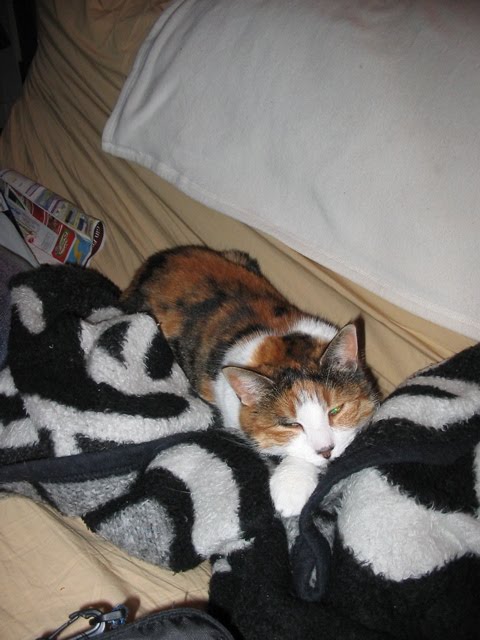
We were having a normal spring up through yesterday, which means rain and sun breaks, but mostly rain, and that was a shame because I had to have our cat Rosie put to sleep yesterday, and she very much would have enjoyed a few hours laying around in a warm puddle of sun before she had to go.

Rosie has been living at my parent's place in Port Hadlock since we moved aboard our boat last summer. Diagnosed with a chronic condition just as we were getting ready to move, we didn't feel right just giving her to someone else. But she had perked up quite a bit after we moved her there and didn't show any signs of moving on from her ninth and final life anytime soon.

We spent the winter with her while my folks were out traveling. She seemed to be normal, happy, and healthy, but toward the end of our stay she was sometimes forgetting to go outside to go to the bathroom, and she was sleeping a lot more than usual... pretty typical old cat behaviors.

After we left, though, she was eating less, forgetting to go outside more, and sleeping even more often. When we went back up last week for our haul-out in nearby Port Townsend, we were shocked at how skinny she had become. As long as someone remembered to put her outside in the morning and evening she would go to the bathroom out there; otherwise, she was hitting the living room carpet more often than not.

So it wasn't like there weren't signs that she was deteriorating, but she was so small that it doesn't take long for things to go downhill seriously if she hits a tipping point of some sort. After we sailed back to Seattle, she pretty much stopped eating and drinking entirely. She stopped sleeping in her favorite spots and instead camped out in a corner of the living room behind a potted plant. So, after a phone call from my mother not a week later, I drove back up on Friday to see her for myself and take care of the necessary arrangements.

We made an appointment to have someone come out and do it at home on Saturday, since she has always hated car rides and I wanted her to be in comfortable surroundings and not stressed out at the end, but once I saw her it seemed clear that wasn't going to be a factor. She was just listless and generally unaware of her surroundings, although she did purr a bit in the morning when I got there and petted her.

But she wasn't getting around well, even when she tried. When she showed some signs of interest in the water bowl, I put it right under her snout but after sniffing at it, she just lay down right there with her head on top of it. She wasn't feeling good, and I didn't want her to feel like that for another day.

Mandy kept urging me to take her outside and let her lay in the sun or play or just feel free, but it was really pretty crappy outside. It cleared up in the afternoon. In fact, it was miserable when we went into the vet, and sunny and clear when we came back out, which just seemed cruel.

She barely objected at the car ride. It was like she seemed to know that she shouldn't want to be in the car, but it turned out not to bother her once she was there. I just held her in her blanket on my lap. She meowed half-heartedly for a few seconds and then just lay there. The vet is only about two minutes away, so it wasn't much of a ride.

I was very pleased that the vet who was there happened to be a friend of my parent's, who had been at their house and knew Rosie, and she him. I think, though she was zoned out from pain meds that we gave her before we even left the house, that it helped that everyone in the room at the end were friendly people that she knew. She was a very sweet, sociable cat.

One of the assistants at the vet said that typically, calicos are the redheads of the feline world, very temperamental (I knew exactly what she meant!) but Rosie had, in the time that we had her, become very much a people cat. She liked people and they liked her. When we first brought her home from Spokane, we didn't see her for a week. She spent all her time under our bed or dresser. But gradually, she warmed up to us, and when our other cat, Hobbes (previously deceased), wasn't hogging all the attention, she would sit on us or with us wherever we happened to be.

She was also the better mouser of the pair, that being the ostensible purpose for introducing the cats to our house in the first place, quickly clearing it out. Later, she would get bored and from time to time catch a mouse or bird outside and bring it IN, which wasn't exactly what we had in mind. But she was well-behaved and good with adults and kids alike.

She loved finding a patch of sunshine and zoning out for her mid-day naps there. Which is why it is so hard, now, that this is the first day of summer. There are puddles of sunshine all over the place, but no Rosie. She was a good cat, and she deserved her sunshine. I wish I could have given her one last day of it. I don't know how her day would have been today, or her night last night, and there is some part of me woke up this morning relieved that she was not still out in her corner too weak to hold her head up. I'm glad to have spared her more of that. But I can't keep from looking around and thinking it would have been a little bit better for her if I could have found her some sun before having her put to sleep.

It would be poetic to say that I had buried her in a place with a nice patch of sunshine, but instead I picked a spot on the bluff near my parent's house (adjacent to, but not within, the previously established chicken graveyard) with a view out over the water, and some nice weeds to hide and play in. She loved to stalk. And for the past year, one of her favorite spots has been up on the back of a chair where she can look out over the bay. But there was not sunshine there, either. So I figured she would appreciate the view more. I hope so.

She was our friend.

Tuesday, June 8, 2010

We're bad luck for planes

This makes three crashes or forced landings we have overheard while underway in the past three years. Of the other two, one was off Anacortes and the other near Shilshole. We were about ten miles away from this one, which is about two hours for us under power, so like the others, we just listened. It wasn't clear at first from the Group Seattle pan-pan that it was a float plane; when the first yacht on-scene called in (and they got to them within about fifteen minutes, pretty quick) and said the pilot was looking for a tow, we figured it probably hadn't been too bad.

Monday, May 3, 2010

A day for random events

The weather station in Port Townsend, across the bay shows gusts to 27 knots, but the wind is out of the north and they are somewhat sheltered by the lay of the peninsula there. The Smith Island station is showing gusts near storm force, 42 knots, and if we're not getting that here in Hadlock, it's gotta be pretty close. Tree limbs and detritus have been smacking the windows all day, and limbs are coming down in the driveway. Apparently they are coming down elsewhere, as well, because a couple hours ago the power went out, and stayed out until just now.

The wind is causing havoc out on the water. I've had the scanner on most of the morning, and now again that I have power for it, and Channel 16 is busy with warnings and calls for assistance. A vessel off Camano Island had the mast come down. As I listen, they have not been able to cut it free, and it's damaging the hull as they creep along toward shore.

Also, just coming across now, another vessel has activated its EPIRB somewhere nearby. No contact has been made; it may have just gone overboard from a boat at anchor. But maybe not.

The Coast Guard has been busy reporting vessels adrift, and the Port Townsend ferry has sat firmly at the dock in town, checking in with passing vessels for conditions in mid-channel from time to time. They haven't heard any reports yet they have been happy with, because there they still sit.

Out front, a vessel that has anchored out all winter here in the bay, a big forty-something footer called the Fram, is dragging down toward the beach. Another, smaller boat is dragging in right along with her, but it started further out and isn't as close in yet. I tried calling the marina nearby, where I think the owner keeps his dinghy, but there was no answer... I suspect the power outage may have done in their phone system. I looked up the boat in the national vessel registry, which has several Frams, but the most likely candidate didn't show a name for the current owner. Finally, I gave in and called Port Angeles, where I got a very harried duty officer who took down what information I had on the vessel but didn't seem too optimistic that they could locate the owner. If she comes ashore, it'll be a much bigger mess than the little 27 footer that washed up in the last storm.

There may be hope, though. The tide is out, and as she comes in shallower, the effective scope on the anchor rode increases, providing more holding power. She has been catching off and on as she drifts, and it may dig in here close enough that the scope provides an effective grip for the wind and wave strength. If that happened at high water, she might still go aground when the tide receded, but if she catches, and if the wind lets up before high tide, then she may just be okay. A lot of ifs... but it's a pretty nasty blow.

Since the power was out when I was doing all this research and calling, I had to tromp up to the shop and get our generator down to charge my phone and get some Internet service back. Back in the woods, if one can put out of one's mind the possibility of being squashed by a falling tree limb for a moment, it's actually quite a pleasant day. The wind is all overhead, the sun is shining brightly, and it's pretty warm out. I didn't linger to sunbathe, however.

My folks will be back soon and so I spent yesterday making sure their bathroom, little used in the back part of the house while they are away, was spic and span. Today I went back there and found some splotches of what look suspiciously like bird poo, blood, and a scattering of very tiny little feathers on the tile. I can't, however, find the culprit, which leads me to believe that somehow, the cat, who is confined to the house and to a very small netted run outside it, somehow contrived to lure in, catch, and eat a bird in the house. That she managed to accomplish this never-before-attempted feat the very day after I clean the part of the house she chose as a dining area is not, I think, coincidence.

The chickens seem to be coping well with the weather, but then, they are chickens; I'm not certain they understand anything that is going on outside the coop. Branches keep clattering down on the roof but they take no notice. They seemed very displeased I didn't have any of their favorite corn feed for them when I stopped in to collect eggs on the way back from the shop.

This morning, the UPS guy stopped by the place for the first time ever. It wasn't for me, but the package was of interest for other reasons, none of which are worth going into here.

And, I found out the my buddy Loyd passed the Washington State bar. He'll be sworn in by next week.

Got a text from another friend I hadn't heard from for almost a year.

So that's it. So far just a bunch of random stuff happening with no real narrative line. Some days are like that.

Wednesday, March 31, 2010

These trips to town

Okay, so this is a long, and rather whiny post. My apologies up front.

For most of fall and winter, I had my students to confined to Mondays. I only rented my office in Seattle for that day, and everything was working out okay. It wasn't ideal, because getting to Seattle for a day every week gets rather old. It isn't a short trip, and since it involves a ferry, it can end up taking a really long time.

Then, somehow I ended up with an Internet student, via Skype, on Tuesdays. It would be impossible to do a Skype lesson from Hadlock with our sketchy (at best) Internet connection. So I began staying in Seattle until Tuesday late afternoon.

This week I was going to be heading south to Tacoma on Sunday to have dinner with two of my friends from my former AmeriCorps team. I don't mind to drive around Puget Sound from time to time, just to change the routine of the ferry.

After dinner I headed up to Seattle to spend the night on the boat. A storm had moved in and it was windy and raining hard ALL night. I did not sleep very well, and woke up still tired.

Luckily, Monday was an unusually light teaching day with only one student in the afternoon. After that a former student was coming to the office to be a guest on an upcoming podcast about Russian speakers. To thank her for her help, I was going to take her out to dinner.

Since my office is shared with others, I usually have a very specific routine when I lock up. I pay extra attention to having everything in its place. This time, since I was only going to be leaving for a while, then coming back, I just locked the door and left - with the keys still in the office. It was one of those things you remember just as the door clicks shut behind you. Normally there are people an the adjoining area of the suite who I'm pretty sure have access to my part of the office, but this week, for the first time in months, the rest of the place was empty. Since it was after business hours, the building maintenance guy was already gone for the day. Luckily I had my phone with me and was able to contact someone with a key to open it up. However, aligning all of that distracted significantly from my thank-you dinner with my nice student. Three hours after locking myself out, I was back in again and able to retrieve my computer and the rest of my things. I felt like a big dork who was doing a good job of inconveniencing others. And my mood was shot for getting much of anything else done. And I was dead-tired.

Monday night the boat was much calmer and quieter, but I kept having a dream such as I've never had before. I kept dreaming that I was at a family get-together, but I was so tired I kept falling asleep in my chair. I've never dreamed about sleeping before; it's kind of weird.

Tuesday morning I headed over to West Seattle. I have a corporate class next week and the guy who prints my books had them finished and ready for me to pick up. I had until 3:00pm before my student, so I decided to stop in at the Alki Starbucks and get some more Internet-necessary work done. (I never get tired of the view from that Starbucks.)

At about 2:00, I got in my car to head up the hill for the books. Nothing. Dead battery. Lights on. Damn. After yesterday's keys drama, I'm pretty sure I'm a complete idiot.

Oddly, Scott is in town at this point. He's got jury duty at the downtown courthouse on Wednesday, and a client of his needed him to stop in for something on Tuesday. But he was not in town with a vehicle, since he had bussed it from Hadlock and had just arrived. So he could not be of much immediate help.

Anything but help within a few hours would be bad because we've been dog-sitting for a friend for the month of March, and poor Daffy had been home, alone, since before noon. She's not really the kind of dog that sits home alone for very long all that well. With my and Scott's original plan, she had about 6 hours, which is already quite a long time. Much more would not be good.

I turned around and went back into the Starbucks to check out what options I could find online. The place that I usually conduct online classes from is very near my office across town because that is where I get the best Internet connection from. I checked to see if any of my friends in town were available, but I was out of luck. I called the nearby Alki Auto to see if they offered jumps. They said they could lend me their portable charger, if I wanted. Perfect. I can do that. But by this time I didn't have time for that before my 3:00 student. So, at 3:00, I Skype my student and explain that I can do her lesson, but I am stranded in a rather loud place. If she had trouble hearing me, I could reschedule her class. But she is fine with the background commotion of a coffee shop at the time of day when everyone gets off school and work and is rather rambunctious.

At 5:00 I hoof it the five or so blocks to the auto place and gratefully accept their portable charger. Simple right, connect red to red.

Back at the car with the hood open, I take a look at my battery. There is nothing red. There is nothing with a plus sign. There is no indication whatsoever of which side is positive. I looked at the manual. It did a nice job of pointing out how to secure the battery and such, but was not giving me any clues about which side was positive.

I looked around for a man. Except for those out running along the beach, there wasn't really anyone around. I figured if I stood there long enough looking at the engine of the car, someone would notice me. Who notices me is a woman, about my age, out walking her two fluffy white poodles. She assures me that hooking it up backwards is not going to cause my face to burn off in battery acid. Seeing my trepidation, she offers to hook it up for me. Now, I hate being a wimp, especially a stupid wimp. I figured if she was willing to do it, I could to.

I hook up one side.

I barely touch the other side, and a small spark sparks. "Nope, flip 'em around," she says. She still seems quite confident in herself. She assures me she's done it many times herself.

So I do.

"Okay, you can start the car now." So I do. And then she's off, returning to her poodles' daily walk. I like smart women.

I unhooked the charger and drove it back to Alki Auto. It was still early enough to go pick up the books, but that would have meant turning the car back off almost immediately, and I'd rather not do that, so I headed straight back to the ferry terminal, still nervous of turning it off. Since I hadn't eaten since breakfast, hunger won, and the I turned it off to grab some food from the McDonalds that adjoins the Seattle Ferry Terminal.

In all, I was only one ferry later than I would have been with no dead battery, so I was hoping Daffy would be okay still.

Then I got to the Hood Canal Bridge. As I approached the bridge, the lights began flashing, noting a bridge opening. I could see the waiting vessel that we'd be opening for. I've had to wait for this bridge to open before, and it is not a quick process. I didn't time it, but it is easily a 20-30 minute wait from closed to open to closed again...

I finally got back to Hadlock a bit after 8:00. Daffy's little bladder could not wait so long, and she had other signs of distress at thinking the rest of the world had abandoned her. Her dog parents will come and pick her up later today, and I'm sure she's happy about it.

Today I just feel like taking it easy and watching Samantha Brown and Anthony Bordain on the Travel Channel. I don't feel like diving into my work, even though I feel like I've wasted so much time earlier in the week cleaning up messes I managed to create for myself.

I'm ready to sell my car. I've been ready to do that for months, yet I haven't done it.

Mostly, I hoping that if Scott and I find ourselves here again next winter, I do NOT need to make these weekly trips to town.

Monday, February 15, 2010

Karma

Regarding my grounding the other day, Mandy had this to say: "I think hitting a rock (and this time, not causing serious damage to the boat) is a message to him to lighten up on his shipmate...."

I knew there was going to be some sort of smug response coming there (although I will remind her that we're basically tied; it's not like she wasn't on deck or participating last time around, and she has run aground before all by herself), which must be satisfying in some regard, but to me, just seems to illustrate that perhaps neither of us should be out doing this together. If I'm not careful enough (obviously, I'm not) and she is less careful than I am, then that's sort of a bad combination, isn't it? It would be nice to have someone competent on board. This is at the very least, after all, our home we're talking about here.

It's also far too early to assert, as she did, that there is no significant damage. That sort of collision can cause significant damage to the keel, weakening it or straining to bolts in ways that don't cause leaks, but which can lead to catastrophic failure later on (there is a somewhat well-known incident that happened in the Gulf of Mexico of this sort where most of the crew was lost). Or, the keel can be bent or twisted out of true, costing tens of thousands to repair. Until the boat comes out of the water (which we were, fortunately, planning to do this spring anyway) there's no way of knowing.

This, no doubt, will be added to the "overkill" list of severe lectures on safety and caution that I give.

Friday, February 12, 2010

Silva Bay

We made it to Silva Bay this afternoon as planned, and caught a spare guest slip at the Silva Bay Yacht Club at Pages Resort and Marina. We're taking the opportunity to charge up, warm up, and dry out a bit. If I had more energy, I would go up and browse through the books in the marina office... it's also a book store! It's been wet, but we have been generally warm enough despite the sometimes balky diesel stove, and we've been making good time and hitting most of our stops according to plan. The weather has been lucky; it was only brisk during our crossing of Rosario Strait, and downright calm coming across Haro (although wicked rollers spoke of mightier winds somewhere south of us).

We cleared customs in Sidney and spent the night last night in Montague Harbour. Had a bit of drama coming out again... I put her aground rounding Gray's Point. A rising tide, liberal use of reverse, and (mostly) a halyard to a passing BC Hydro crew boat got us off quickly. Actually, I had been veering further inshore than I had planned to make way for the crew boat, who was coming up from astern; I can't figure out if that was bad karma, in that I ran aground trying to be nice, or good karma, in that the boat I was being nice to stopped and helped us off again. Anyway, I am sure the leading edge of the keel is a mess but no other damage, and the worst part is that this puts Mandy and I at 1-1-1 in the running aground department. I'm really sweating who hits bottom next. I'm also calling out everyone who told me I shouldn't feel dumb about having done it last time; clearly you are all wrong, I really am that stupid, and apparently this is going to be an annual event. Once may be a learning experience, twice is just dumb.

Anyway, I actually had a fairly nice sail after that, wind almost right astern... I shook the genoa out and rocketed up Trincomali Channel, one of the best places in the world for a dead downwind sleigh ride. Last time we caught it coming down from the north, but the place is just like a funnel, and it's laid out like a drag strip: only one way to go, as fast as you can.

Unfortunately, like last time, the wind dropped off the further we got, so I ended up firing up the engine eventually and then battling my way out of Gabriola Pass and into Silva Bay. The southerly whipping up the Strait of Georgia against the flood coming out of the pass had us on a roller coaster ride, and the entrance to Silva Bay is moderately intricate even if you hadn't already run aground once that day. The interior is clogged with moored derelicts. I'm more worried about trying to get out past them tomorrow morning, though, in the dark.

Right now, the forecast is about perfect; the winds in the Strait are supposed to drop from 15-25 to 10-20 overnight and veer south, which will put us on a sweet beam reach right for Vancouver. They aren't forecast to pick up again until late morning, by which time we should be well within English Bay.

Speaking of which, the kid at the gas dock in Sidney next to the custom's float told me there were three frigates standing guard off Vancouver during the games. He wasn't kidding. I heard them hailing and stopping sailboats on the VHF all day long today. I expect we will receive similar attention as we approach tomorrow... hopefully not too much of delay.

For all that, it may not matter ultimately. When we went to register at the marina office, the lady at the desk asked where we were headed, and when we told her, asked if we had tickets for anything. We told her that, too, and she gasped and said, "Oh, had you heard the news?" We hadn't. It will cast a pall over the event tomorrow, if in fact they decide to have the event at all... there hasn't been any decision so far. And it certainly puts grounding a boat into perspective in the scheme of things.

Monday, December 7, 2009

Shivering our timbers over here

It's cold out, and getting colder! Checking the forecast last week, I saw temperatures predicted down just below the floor of normal, which bumbles along in the forties and fifties this time of year. That was enough to make me a little nervous; our hull paint, the big project we had planned this week, requires twelve hours over forty degrees to dry. With the predicted winds also making rudimentary tarp-tents impractical to keep the area around the boat at least somewhat warm and protected, I was getting a little nervous about going through with the scheduled haul-out at all, even though I had already obtained all the supplies I needed and though Don had already scheduled a flight over here to help out with the tasks.

My concerns only deepened over the weekend as the forecast got colder and colder. Now they are predicting temperatures below freezing all week, with lows in the twenties. I'm not brave enough to look outside right now and see what it is here in Hadlock, but I do know without a doubt it's going to be too cold to paint. So, as soon as the yard opens, I'm on the phone to cancel with them. The haul will have to wait for next spring.

There are other problems, though, with sustained temperatures so low... frozen boat plumbing! Normally, the waters of Puget Sound, frigid though they are, act as an excellent insulator for the boat systems. As long as the water isn't freezing, then generally nothing inside the boat will be freezing, either. But last winter, skeins of ice started to form in the marina slipways when it was cold and snowing, and I have little doubt the same will be happening this week.

Fortunately, haul-out or not, since Don is already on his way over, I'll be at the boat anyway and can keep the heat on and keep it above freezing inside, at least. That brings up another question, though, which is, exactly how much above freezing can I keep it? I have the built-in diesel heater and two small electric space heaters. None have massive BTU outputs, but in a small space, that generally hasn't mattered. But it's a small space without any insulation to speak of... if I can't pump more heat in than it is losing through the fiberglass skin in a given amount of time, it's liable to still be pretty damn cold aboard. We haven't before had to deal with living aboard when it's this cold out. Well, maybe Mandy has, but I haven't asked her about it. Either way, it is not without trepidation that I head aboard today... at least the boat will be preserved for future use and protected from expensive repairs by our presence, but how much we will enjoy the experience, I can't really say.

Friday, August 28, 2009

Miracle on the Elliot

At least, that's the overblown (or perhaps intentionally ironic; always hard to tell with newspaper quotes) description of this event offered by an SPD Harbor Patrol officer.

We overheard the drama on the radio this morning as we came down to Bremerton from Port Hadlock. Due to our distance from things, the only clear transmissions we heard were those of Sector Seattle, but it sounded as if the responding boat owner, as he is identified in the article, was in fact the local Vessel Assist captain. The Seattle Vessel Assist boat is moored at the base of the ramp that goes to our slip on Q dock, so it would have been pretty well situated to respond, much closer than any police or Coast Guard vessel, assuming the skipper was nearby.

Unrelated, but moderately exciting for us avid Captain Rodriguez followers, we also overheard Remedy for the first time, at nearly the same time.

Thursday, August 6, 2009

Contrary to forecasts... - 05AUG09

Contrary to forecasts (I wonder if I even need to continue saying that? Weather is hard to predict up here, the forecasts are frequently inaccurate) the winds were from the southeast and the skies were overcast as we left behind Barter Cove and headed for Esperanza Inlet. A few sea otters waved goodbye as we left and forlorn looking abandoned houses kept vigil over the empty bay.

The winds were light but we made them work, getting south to Esperanza by sticking close to shore but just outside the many rocks and reefs dotting this section of the coast. Mandy continued her streak of bad luck from yesterday by getting seasick about an hour out. Her hand was still swelling from the wasp sting from yesterday as well, but she managed to stand half a watch despite all the troubles.

We're in Queen Inlet now, which is not exactly an anchorage fit for a Queen... holding is okay, but it's windy and there are a lot of crab pots to dodge, no doubt placed by the inhabitants of the many houses/cabins along the shore here. Some of them are abandoned as well, including a neat old place that looks like it may once have been a church. There is also an apparently more recently wrecked (beached?) fishing boat in a cove off to one side. We're not sure what is up with all the empty places, though, this seems like prime vacation territory, and all the recreational fishing boats out and about would seem to indicate that others agree. They seems mostly to come out of large fish camps, though, rather than summer cabins and the like. Apparently this is also something of an accident of timing, since Jason and Christy of Hello World found a pretty hopping scene in the Cove when they passed through less than a month ago. It also inspired them to get out and explore and take some pictures, which they include in their post... worth a look for the other side of the story!

I did see a pretty cool outfall from a large tide pool just outside the cove entrance on my way out in the morning... Mandy was still in bed and I was too busy fiddling with the autopilot to take any pictures. For some reason the fluxgate compass doesn't appear to be tracking correctly; I swung it but need more sea room to do a complete recalibration, which can wait.

We're continually surprised at how populated the West Coast of the Island is; nothing we have read indicated anything of the sort, with words like “desolate,” “wilderness,” and “distant” featuring prominently in descriptions. Instead, it's thronged with people out fishing. We seem to have left most of the other cruising boats behind, or perhaps we are behind them, in a bubble of sorts. But there are no shortage of people or settlements around here.

Not that it gives us much sense of security; we heard a call on the VHF today coming into Esperanza from a small fishing runabout on the rocks to our south, about an hour from our position at our speeds. Despite the bay being carpeted with other small craft, none of them answered... apparently they don't use radios. The flip side to that, and it's a big plus for us, is that there isn't all the constant and tedious chatter on the distress and hailing frequency like there is on the Inside. But the Coast Guard had to come out and tow these folks back to their camp, despite there being probably twenty other boats that were closer and could have done so just as easily and much sooner.

Considering all the small craft and the notorious conditions out here, I am a little suprised that there isn't more Coast Guard presence. The call issued above was answered by the Tanu, which just happened to be off Barter Cove that morning (they're following us; we saw them near Winter Harbour as well). If they hadn't been present, as far as I can tell Tofino would have been the closest base from which assistance could be dispatched. I think Tofino and Bamfield are the only CG stations on the West Coast of the Island for that matter. There is excellent helicopter coverage from those and bases on the other side of the Island, of course, and that means lives are well-guarded (so long as flying conditions cooperate) but it is easy to lose a boat without another boat nearby sometimes.

But then, the Coast Guard is not immune from trouble here, either. Several days ago, we overheard a Mayday relay from the Otter Bay, which had struck a rock and was sinking, from the sounds of it somewhere along the Central Coast. It's rough country out here; it's a lot of fun, but it's worth keeping in mind how easily and dramatically people can get into trouble, and keep an ear out to lend a hand if need be.

Tuesday, July 21, 2009

Now departing Victoria

It's been a swell visit but it's time to get rolling; we're heading north out of Victoria today and we'll see how far we get on a flood tide and with the wind at our backs.

We may get trapped by the current gate at Dodd Narrows, but it would be surprising if we get that far today anyway, so I'm not going to worry about it much.

We just need to grab some coffee, some provisions, and my Powerbook cord (we got a call that the package came in yesterday but the marina office was closed before we could pick it up) and we will head out. The weather is still beautiful and it's another place we sort of hate to leave, but we have places to go and things to see.

The radar issue is still unresolved despite my having put Mandy up the mast yesterday. When she snugged down the data cable, it fired up, but then when I turned off the charger, it went back down again. It turned out the hardware I got to replace the battery cables was (of course) just barely the wrong size, so I just cleaned them up and put them back on again. When she came down, the thing was working, but I still don't trust it. Fortunately, no fog in the forecast today, and it shouldn't be much of a problem along the inside route so we still have a week to work on it.

Friday, July 10, 2009

Flip-flopping like a politician

So, I've decided it is the radar acting up again; not a small burr on the connector, not the batteries, but the Raymarine 2KW radome itself.

I may flop back again, but that's where I am at with it right now.

When we took the cat up earlier this week I took the opportunity to go out and take a more in-depth look at the problem. I had become convinced (erroneously, it turns out) that the radar had failed to work on our most recent sail due to low battery voltage... low voltage that should not have been there considering they've had several months on AC shorepower to soak up juice. This theory was formed when the unit failed to function while we were under sail (resulting in a "No Data" message on the radar display of our C80 chartplotter), but fired up immediately when we turned on the engine (consequently engaging the alternator to supply electricity), and was reinforced when I checked the voltage the next day and found it hovering around 10.5v... fully discharged in a 12v system.

Turns out that it was my multimeter that should have been "discharged" since when I took Graebel's much better device out, together with a specific gravity tester, they both showed the house bank at nearly full charge. Moreover, the radar wouldn't engage either off the house bank or when the engine was on and the alternator putting a full 14v into the system. Same "No Data" message (which isn't, incidentally, covered anywhere in the Raymarine documentation that I can find).

I checked all the connections on the low side of the system again. I verified that the C80 unit is putting out 12.5v through the radar cable connector, and I tested the impedance on the necessary data pair as shown in the Raymarine troubleshooting document, and it comes in at 113Ohms, lower than the 160 they specify. I think that is better, isn't it? But nothing I tried could get it running, and nothing I tested on the deck end showed any trouble.

Someone is going to have to go aloft and check the internal connectors at the radome. Hmm... I wonder who?

I'm a little nervous about it, actually; the only way to test the power at that end is to actually have the system powered up, which is usually not recommended. It is possible to have the system powered, but not in transmit mode, which will save the tester on any RF exposure, but if I recall correctly, the default startup state is "transmit." So, say it's not working, she accidentally wiggles whatever wire is causing the problem, and it fires up? I'll probably have to call Raymarine and see what they recommend.

Anyway, this is my number one problem at the moment. I am relieved that the batteries are in good shape, but no radar, going onto the rocky west coast, coming into the month known affectionately as "Fogust" by locals, is not a pleasant prospect. It need not be dangerous; we will simply have to sail in good weather and our options will be impeded by that requirement.

That said, the intermittent nature of the outages leaves me with some hope that this is simply the result of a loose connector somewhere, and hopefully it will be something easy for Mandy to spot once she gets up there and gets the lid off the radome.

Tuesday, June 30, 2009

The last straw

Or, I should say, the last metering stem has finally snapped on the diesel stove.

Actually, this happened last week but we weren't going to be spending the night in cold weather aboard so I didn't think to mention it. Mandy was reassembling the fuel metering assembly on our troublesome diesel stove when the long stem valve that controls the fuel flow into the burner snapped off... apparently (apparently! right!) it was already bent and when she attempted to re-insert it the stem just broke right off.

This was mixed news; I had long anticipated that our problems with fuel flow would only be solved with a replacement metering valve and this pretty much forced the issue. I had priced them out around $160, which is more than we really want to spend at the moment, but necessity is the mother of large credit card balances. My only question was which replacement metering assembly to purchase; the website at Fisheries Supply showed three, one for diesel, one for kerosene, and one labeled "stove." Well, we have a stove, and it burns both diesel and kerosene, so it wasn't clear which we would need.

Today after we got back from the peninsula, we had to go pick my truck up at Shilshole, so we decided to stop in at Fisheries and ask. We found a nice gentleman named Mike back in the galley department to help us. He was very friendly, warned us up front that he wasn't their stove expert, who was at lunch, but that if we could wait around fifteen minutes, the expert, Dwight, would be back to help. Despite claiming he didn't know much about it, Mike took some time while we were waiting and looked into it and thought he might have found the part we needed, available by itself, for only $15. That was welcome news, particularly since he informed us that the whole valve assembly would be around $180, not the $160 listed on the website. We decided at his recommendation to wait for Dwight and the expert perspective, however, so we did.

Dwight started off on the wrong foot when he showed up and told us it was impossible to be doing something that we had done quite succesfully for nearly five years already. We must have missed the memo. Things went downhill from there. He told us that the part was the wrong one anyway (we had called it the wrong name) and that he was no longer able to order those parts separately anyway and we'd have to buy the whole package. Leaving aside why they were all available in the system, with separate prices, even if they couldn't be ordered (systems can be wrong, I know as well as anyone), we tried to find out whether a dealership or repair center could still get them, and how we might at least try to get just the piece we needed, but Dwight didn't want to countenance the idea. "If you got the wrong thing and put it in and burned the boat down, who are you gonna sue?" he asked. I said it didn't matter much if it was a small part or the whole assembly, if it was the wrong one or got installed wrong, the boat was still going to burn, and the sort of person who would sue would still sue over it. But we at least got a phone number for Dickinson from Mike, and thanked them and left.

Dwight was a lot more interested in telling us what couldn't be done about the problem than what could, and showing off his expertise rather than listening to our needs and helping us with them. Consequently, Fisheries blew off $180 in sales today... I doubt they'll miss it, they cater to a more professional crowd anyway, and I have heard before that the way to get good service from them is simply to be there a lot and be in the business, get to know the staff. If that's what works for them, swell; on the other hand, Seattle Marine Supply also caters to professionals, and they've been nothing but helpful any time we have been in there, despite what must seem very piddly little boat problems compared to what the big crab boat crews come in with.

I am sure that this is an individual problem, since the first gentleman, Mike, was great; but it's a problem I've had with Fisheries before, too, so it seems there is something systemic about it as well. I don't understand it, frankly, particularly in this economic climate: why on earth is anyone making it more difficult for me to give them money? I was all set to drop $160 in there today, and would probably have gone up to $180 if someone had simply talked me through the options instead of shutting it all down with a blanket "Can't do it." Instead, if I do have to buy the whole assembly, I'm going to get it online from someone else for $150, all because of one blowhard. How many times does that happen a day, you wonder?

So that's my... let's see, what is the opposite of a plug? A slug? That's my slug for Fisheries Supply. Strike two!

And I'll put in another plug for Second Wave while I am at it. We stopped there after Fisheries, and they had a whole replacement stove for less than Fisheries wanted for the metering valve. It would be cheaper to buy and strip the parts we need and re-sell the rest. We're still holding out on a conversation with Dickinson, however, or any authorized repairmen or installers we can find in the area. I didn't look at it but Mandy said it looks like the stem simply unscrews; if that's the case then surely we can find a used one or a repairman with a spare that will be cheaper. Failling that, there is a rebuild kit for $50 available online at several chandleries, and I might spring for that just to see if it includes the part (it might be worthwhile for the other spares involved anyway).

Saturday, June 27, 2009

Trepidation

Mandy moved out here from Wisconsin to join an Americorp team working in Federal Way public schools. If you haven't heard of Americorp before, check them out... they do some good work (and hey, it's your tax dollars, you should keep an eye on them). One of the things that Mandy's team does is hold an annual charity auction to raise funds for underprivileged kids to purchase equipment for extracurricular school activities... instruments, uniforms, and so forth that are necessary to participate but which many families in that district are unable to afford. Businesses and individuals donate items or services to auction off and the money goes to buying equipment for those kids who would otherwise be unable to participate in those school programs.

After she bought the boat, Mandy decided to put a day sailing trip up in the auction. Though she is no longer with Americorp, we've donated a trip every year, and it's always done pretty well, giving us warm fuzzies in addition to providing another opportunity to go out sailing. This year's winner has picked this Sunday for her trip, bringing her family along, and we expect they'll have a fine time and it's more money in the bank for the kids. But I have come to view the annual event with some trepidation and all I can think about today is what is going to go wrong tomorrow.

The annual charity day sail, you see, appears to be cursed. The first year, a banjo bolt sheared off in the fuel filter assembly as I was bleeding the lines, just as the lucky winners arrived at the dock. We had to cancel and reschedule. The second year, it was some other engine related problem, though it only delayed our departure instead of cancelling it altogether. The third time, it wasn't our boat, but the Ballard Bridge that broke, stranding us and our hapless passengers on the wrong side for an extra hour and a half. Last year, our starter died. I may not be the sharpest knife in the drawer, but even I can see a pattern developing here.

We both worked on the boat most of yesterday and I couldn't find anything ready to give out, but I am sure it is hiding there somewhere. I changed the secondary fuel filter, fiddled with the transmission (took a little fluid out, it seems to be shifting easier now... apparently too much is worse than not enough) and extracted the problematic pin on the anchor roller, all with suspicious ease. We pumped out and fueled up, and Mandy painted the foredeck hatch and touched up some spots on the mast, and she is back there again today cleaning up. Maybe she'll come home with some tale of woe, I'm not sure. I suspect whatever it is will only reveal itself after our passengers show up, however, as that seems to be the point at which maximum stress can be inflicted.

Making things more fraught is our plan to head north for Port Hadlock immediately after finishing the day sail. Since we're going to be gone for most of July and most of August, we went ahead and sublet our slip out for the whole of both months, so we need to get the boat out of there and up to Hadlock before July 1st. This seemed as good a time as any. The currents will make things slightly complicated, though; if we actually head north as soon as we drop the passengers off, we'll be bucking a head wind and a flood current. We could wait around until 2300 or so for more favorable currents, but then it's dark, and we'd still have the head winds, which would have us tacking back and forth through the shipping lanes with limited visibility. Or, we could hang out until 0400 or so and get both light and ebb current, but then we might not make the Hadlock canal before slack.

Haven't decided entirely what to do yet, but I'm not putting a lot of thought into it as I expect any decision made today will be rendered moot by tomorrow's impending but unspecified failure.