It's a good thing we both like Campbell River, because just about every time we are here, we end up spending at least one more day than we had planned.
That is somewhat understandable due in part to the location of the city. Five miles south of Seymour Narrows, five miles north of Cape Mudge, with no protected anchorages in between in either direction, it's a place you don't want to leave if conditions aren't just right. A southeasterly at Cape Mudge or a stiff northwesterly through the Narrows can cause you to postpone your departure from here indefinitely until conditions clear up.
This time around, though, it's something a little more mundane: the power is out. Around three am, a transformer blew that supplies at least some of the docks with power. A BC Hydro crew is up working on it right now, but as of 11:30 this morning, they are saying it will probably take the rest of the day to fix.
The only reason we were staying for the day in the first place was to get some work done. Now, it's like we're anchored out again (although Internet service has not been affected): we're cooking on propane, washing up in cold water, and relying on our solar panel to keep our computers charged (which relegates me to my tiny Eee PC and only allows Mandy to work about a quarter of much as she normally could... solar charging is slow!). So, not much is going to get done today. We did laundry when we got in last night, went shopping, and were all set just to get online and get stuff done today. Now we don't know what to do with ourselves. I washed the boat, and Mandy plans to patch up our dinghy sometime today. Otherwise, it's possible I might be more bored here than out at anchor somewhere!
We got to Desolation Sound last week two days out from Pender Harbour, and took on some supplies and spent our first night in Refuge Cove. Then we moved to Prideaux Haven, in the Desolation Sound Marine park itself, for a couple of days... it was busy, but not crowded. We moved up to another small Marine Park north of there called Walsh Cove, and that was great. Warm water, sunshine, some small but interesting islands to explore, and some cliffs with Indian petroglyphs on them (or, possibly, doodles by some teenagers with spray paint. I'm undecided). We read in the sun and went swimming. Mandy jumped off a small cliff a number of times. I did, too, but the warm layer of water ends about four feet down, so jumping in gets really cold, at least until you resurface. But as long as you float about in that top four feet, it's very pleasant.
After Walsh Cove, we headed up through Yaculta and Dent Rapids. It's the first time we have taken that back route and weren't sure what to expect. It was a lot of current, but the guidebooks show good techniques for getting through, and we followed several other sailboats with the same general idea, so it was just a matter of connecting the dots. I have some ideas to make it easier and faster next time around; the guides are all written for people going further north, so they advise cutting some corners at the rapids, but I suspect we would have gone through quicker if we had done things differently.
Our swing up north of the rapids could best be characterized as: windy. Gale force winds have been blowing down through Johnstone Strait for almost a month now. There was a lot of chop in all the channels and a lot of wind in all the bays. We stopped at the resort at Blind Channel because Terry keeps telling us how great the bread there was. We missed the bread but got cinammon rolls, which were good; we also hiked up to see an 800 year old cedar tree (just like other cedar trees, only bigger), and I got Mandy roped into judging a dog show. I think she had fun, though. That will all probably get a post of its own, though. I got pictures... she had to wear a funny hat. Funnier than her normal hats, even.
It was a fun stop, but very expensive, as everything up north of the rapids tends to be. Even so, they were full up while we were there. We only stayed a night. Even that seemed like a mistake, since waves rolling in from the nearby rapids kept us rolling around all night even at the dock.
The next night we tucked into a little spot at Turn Bay just out of the main part of Johnstone Strait. That was a nice little nook, but the wind blew in fiercely. It was the same story at our next stop, Small Inlet in Kanish Bay. Small Inlet actually isn't that small, but we were the only boat in there. A couple of kayakers came through in the afternoon, but that was it. We rowed ashore and hiked up across a low saddle to Waiatt Bay (sp?) which was chock full of boats. It also happens to be, in a convoluted way, south of all the rapids, which explains the difference. It was a great little hike, but a very strenuous row back to the boat, since it was all upwind. Also, we blew a leak somewhere in the dinghy and it wasn't as rigid a platform for rowing on the way back.
That night the gusts came in and batted us around pretty good, keeping Mandy awake much of the evening, but our anchor held like a rock. Even though she was tired the next day, she took the helm through Seymour Narrows coming south... it was uneventful, though, as our timing was right on and the wind was with us.
So here we are in Campbell River for two nights plus an extra. After this, we'll poke around near Desolation a bit more, then head down to Vancouver for our various trips stateside in mid-August.
Thursday, July 29, 2010

Saturday, July 17, 2010
A short time-out
We had intended to head north from Nanaimo pretty much directly (with overnight anchorages, obviously) to Desolation Sound, but events have conspired to keep us in Garden Bay for at least another day.
First, yesterday was a pretty rough crossing, at least in part. The Strait of Georgia lived up to its reputation for roughness as we cut across the western half... short, sharp chop and gusty winds had us burying our nose in saltwater and Mandy heaving over the side despite medicative precautions. We were both exhausted by the end of the day and in no mood to get up and press on immediately this morning.
Second, this morning was Saturday; yesterday, then, was Friday, and that makes it a weekend, and we inadvertently put ourselves on the same track as hordes of vacationers from Vancouver and Nanaimo, who showed up shortly after we did and turned the bay into a big parking lot. A lot of these folks have the same general plan that we do, which is to overnight here and head on to Desolation Sound... that means they'll be at anchorages between here and there today, and up there through the weekend. If we wait a day, we should be able to find relatively open places as we work our way north along behind them.
Third, I noticed the bilge pump coming on more frequently than usual yesterday after we started the engine, and when I opened the engine compartment for inspection, my suspicions were confirmed... the muffler had sprung a leak again. I pulled it this morning to repair it, and sure enough, there was a new hole, adjacent, of course, to the part already fixed. I laid some liquid metal into it and will let it cure today; hopefully it will be okay tomorrow. I suspect that I botched the job... the liquid metal filler stuff sets up much faster than I expected and I didn't get it laid into the hole as deeply as I was thinking. But there's no sense in putting more in if that layer won't hold, so I will just have to put it all back together and see if it blows again. If so, I'll get an opportunity to do it right, although I'm not looking forward to it. The weather is too nice to be all jammed up in the lazarette messing with hose clamps.
Anyway, we wanted to take a crack at it while we are still only a day's sail away from major ports like Nanaimo or Vancouver, which could still fix us up if I really botched things.
Finally, our anniversary is tomorrow, and Mandy wanted a nice night out, and this is probably the last place anything of that sort will be easily possible. So, she'll have it a night early, assuming we can get in at the Garden Bay Hotel, which is reputed to have an excellent spread.
First, yesterday was a pretty rough crossing, at least in part. The Strait of Georgia lived up to its reputation for roughness as we cut across the western half... short, sharp chop and gusty winds had us burying our nose in saltwater and Mandy heaving over the side despite medicative precautions. We were both exhausted by the end of the day and in no mood to get up and press on immediately this morning.
Second, this morning was Saturday; yesterday, then, was Friday, and that makes it a weekend, and we inadvertently put ourselves on the same track as hordes of vacationers from Vancouver and Nanaimo, who showed up shortly after we did and turned the bay into a big parking lot. A lot of these folks have the same general plan that we do, which is to overnight here and head on to Desolation Sound... that means they'll be at anchorages between here and there today, and up there through the weekend. If we wait a day, we should be able to find relatively open places as we work our way north along behind them.
Third, I noticed the bilge pump coming on more frequently than usual yesterday after we started the engine, and when I opened the engine compartment for inspection, my suspicions were confirmed... the muffler had sprung a leak again. I pulled it this morning to repair it, and sure enough, there was a new hole, adjacent, of course, to the part already fixed. I laid some liquid metal into it and will let it cure today; hopefully it will be okay tomorrow. I suspect that I botched the job... the liquid metal filler stuff sets up much faster than I expected and I didn't get it laid into the hole as deeply as I was thinking. But there's no sense in putting more in if that layer won't hold, so I will just have to put it all back together and see if it blows again. If so, I'll get an opportunity to do it right, although I'm not looking forward to it. The weather is too nice to be all jammed up in the lazarette messing with hose clamps.
Anyway, we wanted to take a crack at it while we are still only a day's sail away from major ports like Nanaimo or Vancouver, which could still fix us up if I really botched things.
Finally, our anniversary is tomorrow, and Mandy wanted a nice night out, and this is probably the last place anything of that sort will be easily possible. So, she'll have it a night early, assuming we can get in at the Garden Bay Hotel, which is reputed to have an excellent spread.
Friday, July 16, 2010
Images from Nanaimo
Nanaimo seems like a town that's really trying to be somebody. I think, if it weren't for the financial meltdown, it could have been almost there by now. Instead, there is a dying shopping mall a few blocks from brand new, vacant (but lovely) buildings, and a highly touted, through barely-there "Old Town." I hope, that once North America actually recovers and small business starts to grow again, Nanaimo will thrive. It certainly seems to have the waterfront infrastructure to become a tourist destination and lovely getaway.
 A nice pedestrian friendly waterfront (McGinn, take note).
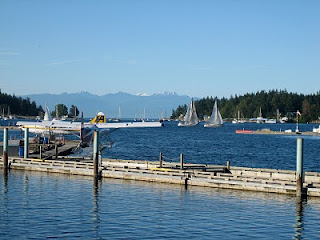 The Nanaimo constants: seaplanes, sailboats, and mountains
 Roses along the waterfront
 New waterfront construction, waiting for occupants (like too many of the rest of the buildings).
 Old Town, which covers a whole block, and seems to be mostly new buildings (except this string of facades), seems to be facing some challenges as well.
 The truest sailboat name ever
 Departure day sunrise from Mark Bay
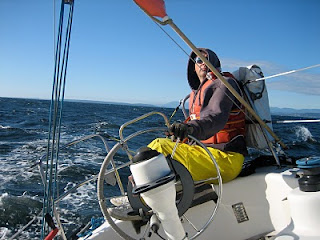 Goodbye, Nanaimo. Seeing ourselves out in fresh Northwesterlies. Next stop: Garden Bay, Pender Harbor, mainland British Columbia
 A nice pedestrian friendly waterfront (McGinn, take note).
 The Nanaimo constants: seaplanes, sailboats, and mountains
 Roses along the waterfront
 New waterfront construction, waiting for occupants (like too many of the rest of the buildings).
 Old Town, which covers a whole block, and seems to be mostly new buildings (except this string of facades), seems to be facing some challenges as well.
 The truest sailboat name ever
  Departure day sunrise from Mark Bay
 Goodbye, Nanaimo. Seeing ourselves out in fresh Northwesterlies. Next stop: Garden Bay, Pender Harbor, mainland British Columbia
Wednesday, July 14, 2010
Marina-stop Balance Challenge
It has taken us a while to find a good coffee shop in Nanaimo. I often think it is overstated that Seattle is addicted to its coffee shops, and that there are too many of them around, often multiple per street corner. I love the Seattle coffee shops; I love the "sameness" of them, and I love the sheer quantity. I am the biggest Seattle cliche. You can get pretty much the same things at all the Seattle coffee shops, which means that no matter which one you find yourself at, you can still get your favorite beverage (I never get coffee, but that is a different topic all together).
This morning, while walking back to the boat after visiting "Serious Coffee" (a place I'd go back to), Scott said he felt like we'd wasted our stay in Nanaimo by not going further from the marina and exploring more. I somewhat agree.
Marina stops have contradictory objectives. On one hand, they are a place to rest the body and mind since there are so many fewer worries, such as how well the anchor is set or if we are too close to another boat, or rock; and the tides (and subsequent anchor rodes) really don't matter when tied to a dock. On the other hand, marinas are an opportunity to get a lot of work done since we have Internet and unlimited power for computer activities. And then there are the necessary things to do as well: get groceries and ice, fill up the water and fuel tanks, do laundry, clean the salt off the dodger with freshwater (so we can see through it again), and pump out our waste holding tanks. The challenge is getting the necessary stuff all done while finding time to rest as well. When the activity of sailing itself takes so much energy, it is difficult to expend an equal amount of energy on onshore activities, too. While the lists say, "Get this done!" the body and brain say, "No." It doesn't seem like it would be so hard, yet I certainly haven't found the balance it seems to require.
In the end, even a stay of three or four days flies past. Onshore activities just aren't as urgent or demanding and at some point rest is needed. I'm trying, instead of fighting the urge to sleep and relax, to just let it be, and not rush through it, even if that means not exploring so much of the city around us. But then, instead of fighting the urge to sleep more, I find myself battling the nagging feeling of "missing something."
I'm going to need more practice at this.
~M
This morning, while walking back to the boat after visiting "Serious Coffee" (a place I'd go back to), Scott said he felt like we'd wasted our stay in Nanaimo by not going further from the marina and exploring more. I somewhat agree.
Marina stops have contradictory objectives. On one hand, they are a place to rest the body and mind since there are so many fewer worries, such as how well the anchor is set or if we are too close to another boat, or rock; and the tides (and subsequent anchor rodes) really don't matter when tied to a dock. On the other hand, marinas are an opportunity to get a lot of work done since we have Internet and unlimited power for computer activities. And then there are the necessary things to do as well: get groceries and ice, fill up the water and fuel tanks, do laundry, clean the salt off the dodger with freshwater (so we can see through it again), and pump out our waste holding tanks. The challenge is getting the necessary stuff all done while finding time to rest as well. When the activity of sailing itself takes so much energy, it is difficult to expend an equal amount of energy on onshore activities, too. While the lists say, "Get this done!" the body and brain say, "No." It doesn't seem like it would be so hard, yet I certainly haven't found the balance it seems to require.
In the end, even a stay of three or four days flies past. Onshore activities just aren't as urgent or demanding and at some point rest is needed. I'm trying, instead of fighting the urge to sleep and relax, to just let it be, and not rush through it, even if that means not exploring so much of the city around us. But then, instead of fighting the urge to sleep more, I find myself battling the nagging feeling of "missing something."
I'm going to need more practice at this.
~M
Getting the point across
I don't recall seeing this on the list of approved navigational signals.
Sailboaters moon Washington State Ferry
Frankly, professional mariners put up with enough guff from recreational sailors, who don't understand some of the limitations of larger craft or the rules involved or the nature of the business, as it is. This sort of thing is completely uncalled for, and probably just makes professional captains and crews that much less likely to extend any courtesy to any of the rest of us when they might have the option to do so.
Sailboaters moon Washington State Ferry
Frankly, professional mariners put up with enough guff from recreational sailors, who don't understand some of the limitations of larger craft or the rules involved or the nature of the business, as it is. This sort of thing is completely uncalled for, and probably just makes professional captains and crews that much less likely to extend any courtesy to any of the rest of us when they might have the option to do so.
Tuesday, July 13, 2010
Fire Raft 2010
As usual, we spent our Fourth of July down in Burien on the waterfront at our friends Ed and Terry's house. Also as usual, the centerpiece of the affair was the floating fire raft, a raft piled high with wood, fireworks, and various other incendiary devices, set on fire from ashore by various means and left to burn throughout the evening.
That was where all the common threads of 4th of July fire rafts ended, though, because this year our friend Maxx is back in town, and he seized the raft by the horns and built, from scratch, a completely new platform and frame, a high-tech, storeable, re-usable, NASA-approved fire raft. I'm including some pictures of the assembly and deployment here; you can find more in our Flickr stream.
It started with two circular sheets of OSB sandwiched together to form a two-ply base for the platform. Beneath, the lids of twenty-five five gallon buckets were glued and screwed to the base, to which the buckets themselves would later be attached for flotation. Above, a lip of 2x4s were screwed down to allow us to pile stuff inside, namely sand, which was hoped to provide sufficient insulation for the wood below to keep the platform from being incinerated as occurs in typical years.


Another innovation was the use of two eye-bolts, on opposite sides of the raft, for both anchoring and control. The far eye-bolt would have a line tied to it, looped through the anchor shackle off-shore, and then back to shore... pulling on the shore-end of this line would pull the raft out into place over the anchor site. To the other eye-bolt another line was attached and led back directly to shore. Used in opposition to the anchor-side line, this allowed us to orient the raft with one side constantly facing shore regardless of wind or current. This feature made our standard ignition system much less fraught, as the line leading to it had less risk of becoming fouled as the raft spun around through the day. It also allowed us to position fireworks that might otherwise prove a danger to those ashore safely on the seaward side of the raft, and to construct a flammable 'basket' of sorts for aiming bottle rockets or roman candles at to set the thing off.
The basket was formed by a seven-foot tall lightweight, pyramidal frame that set within the lip of the platform. The frame stabilized the wood stacked up on the raft, provided a place to hang our accelerants, and gave the whole thing a touch of class, rather than simply being a whomping pile of stuff.
The frame and base were built off-site, then assembled on the bulkhead on the morning of the event. Another change from years past were the tides; there wasn't really a low tide at any sane hour on the 4th this year, so there was water all the way up to the seawall beneath the house and no beach area in which to assemble the raft. This proved most difficult with respect to installing the buckets. They were easy enough to put in place while the raft was upside down on the seawall, but when it had to be turned over and passed down to the water, they tended to bang into things and get knocked off or loose. This was exacerbated by both the increasing weight of the raft, and by the bricks we put in some of the center buckets for ballast. Jim and I argued for additional sealant to be used on the buckets to secure them to the lids screwed to the raft, but we were over-ruled... with disastrous consequences!
 We eventually got all the buckets attached, and with some additional manpower provided by Ed, Maxx's friend Sean, and Ed's cousins Bruce and Justin we lifted the raft down onto some rocks, and then into the water.
This is where the high water complicated matters further: we needed sand to layer the platform with, but had only rock available. All the sand was under two or three feet of water, and we didn't have a dredge handy.
 So, the raft got towed down past the seawall to a small, rocky beach, where we managed to scrape together enough sand to put about an inch over the platform inside the lip. As Maxx objected vociferously throughout the remainder of the day, this was outside of spec, but as later events would show, fire proved among the least of our worries.
 We brought the raft back below the house and as everyone else started stacking it with wood (including the traditional dried Christmas trees, three this year!) I set to work on the secret ingredient: white gas. In years past, attempts had been made to just set the wood on fire directly with roman candles, or to pre-soak the pile in an accelerant, or to position balloons full of gas around the framework and to try to hit and ignite those (you would be amazed how fire-resistant your average party balloon can be). A slow evolution led to open containers, usually bags, filled with gas and positioned around the structure, into which a lucky shot could fall, igniting the whole contraption. Last year, however, I hit on the ne plus ultra of fire raft remote ignition systems: a plastic juice or milk container, half-filled with white gas, suspended from the highest point on the raft near its pivot point, with a line led down from the top to the base of the raft and then to shore. Holes are poked in the top of the container, causing it to form a sort of sprinkler when upended, as will occur when the line led to shore is pulled. This arrangement prevents the gas from spilling and evaporating due to wave action, and allows the pile to be doused with it just before the audience starts firing roman candles and bottle rockets at the thing.
I used a plastic nut container this year, with a small water bottle as backup, and after all the wood and fireworks were positioned aboard, Maxx hung them from the frame. Although the raft has a considerable amount of flotation, it still wasn't enough to allow us to put as much wood on it as was available, or as we had hoped. Still, there was a fair amount and the platform was just above the surface of the water when we pulled it out into position.
As the day drew on, however, the platform began to list. One of the buckets, apparently, had developed a leak. At first this was not significant, and one out of twenty-five wasn't a cause for serious concern. The wind shifted, however, and the waves started hitting the raft on the side it was already listing, causing the platform to take on water and some of the lumber to start to float off. It got worse more dramatically just as dark began to fall, so we decided to go ahead and light it off a little early. Here are the results:
It gets a little shaky after the raft ignites because I was beneath the deck where everyone was shooting from, and a rain of fiery debris started coming down on me. As you can see, though, once again the method has proven quite effective.
The raft burned well into the evening, until we finally put it out from shore with hoses... there was some concern that the hot coals were going to burn through the platform. It was impossible to see through the ash and in the darkness whether or not this was the case, and since we left town the next day I have not yet received a formal report on the post-fire inspection, but it seemed prudent. Also, with the bulk of its cargo burnt off, the listing became less of an issue with the remaining buckets retaining more than sufficient buoyancy to compensate for the leaky one. In fact, I don't even know for sure where the leaks were; we had one bucket that flat out ruptured when we were installing them, it's possible that happened with one or more of the others as well and wasn't caught at launch.
All in all it was a successful effort, but the real test will be if the setup retains its utility to be used again next year as more than just scrap for the 2011 raft!
That was where all the common threads of 4th of July fire rafts ended, though, because this year our friend Maxx is back in town, and he seized the raft by the horns and built, from scratch, a completely new platform and frame, a high-tech, storeable, re-usable, NASA-approved fire raft. I'm including some pictures of the assembly and deployment here; you can find more in our Flickr stream.
It started with two circular sheets of OSB sandwiched together to form a two-ply base for the platform. Beneath, the lids of twenty-five five gallon buckets were glued and screwed to the base, to which the buckets themselves would later be attached for flotation. Above, a lip of 2x4s were screwed down to allow us to pile stuff inside, namely sand, which was hoped to provide sufficient insulation for the wood below to keep the platform from being incinerated as occurs in typical years.
Another innovation was the use of two eye-bolts, on opposite sides of the raft, for both anchoring and control. The far eye-bolt would have a line tied to it, looped through the anchor shackle off-shore, and then back to shore... pulling on the shore-end of this line would pull the raft out into place over the anchor site. To the other eye-bolt another line was attached and led back directly to shore. Used in opposition to the anchor-side line, this allowed us to orient the raft with one side constantly facing shore regardless of wind or current. This feature made our standard ignition system much less fraught, as the line leading to it had less risk of becoming fouled as the raft spun around through the day. It also allowed us to position fireworks that might otherwise prove a danger to those ashore safely on the seaward side of the raft, and to construct a flammable 'basket' of sorts for aiming bottle rockets or roman candles at to set the thing off.
The basket was formed by a seven-foot tall lightweight, pyramidal frame that set within the lip of the platform. The frame stabilized the wood stacked up on the raft, provided a place to hang our accelerants, and gave the whole thing a touch of class, rather than simply being a whomping pile of stuff.
The frame and base were built off-site, then assembled on the bulkhead on the morning of the event. Another change from years past were the tides; there wasn't really a low tide at any sane hour on the 4th this year, so there was water all the way up to the seawall beneath the house and no beach area in which to assemble the raft. This proved most difficult with respect to installing the buckets. They were easy enough to put in place while the raft was upside down on the seawall, but when it had to be turned over and passed down to the water, they tended to bang into things and get knocked off or loose. This was exacerbated by both the increasing weight of the raft, and by the bricks we put in some of the center buckets for ballast. Jim and I argued for additional sealant to be used on the buckets to secure them to the lids screwed to the raft, but we were over-ruled... with disastrous consequences!
 We eventually got all the buckets attached, and with some additional manpower provided by Ed, Maxx's friend Sean, and Ed's cousins Bruce and Justin we lifted the raft down onto some rocks, and then into the water.
This is where the high water complicated matters further: we needed sand to layer the platform with, but had only rock available. All the sand was under two or three feet of water, and we didn't have a dredge handy.
 So, the raft got towed down past the seawall to a small, rocky beach, where we managed to scrape together enough sand to put about an inch over the platform inside the lip. As Maxx objected vociferously throughout the remainder of the day, this was outside of spec, but as later events would show, fire proved among the least of our worries.
 We brought the raft back below the house and as everyone else started stacking it with wood (including the traditional dried Christmas trees, three this year!) I set to work on the secret ingredient: white gas. In years past, attempts had been made to just set the wood on fire directly with roman candles, or to pre-soak the pile in an accelerant, or to position balloons full of gas around the framework and to try to hit and ignite those (you would be amazed how fire-resistant your average party balloon can be). A slow evolution led to open containers, usually bags, filled with gas and positioned around the structure, into which a lucky shot could fall, igniting the whole contraption. Last year, however, I hit on the ne plus ultra of fire raft remote ignition systems: a plastic juice or milk container, half-filled with white gas, suspended from the highest point on the raft near its pivot point, with a line led down from the top to the base of the raft and then to shore. Holes are poked in the top of the container, causing it to form a sort of sprinkler when upended, as will occur when the line led to shore is pulled. This arrangement prevents the gas from spilling and evaporating due to wave action, and allows the pile to be doused with it just before the audience starts firing roman candles and bottle rockets at the thing.
I used a plastic nut container this year, with a small water bottle as backup, and after all the wood and fireworks were positioned aboard, Maxx hung them from the frame. Although the raft has a considerable amount of flotation, it still wasn't enough to allow us to put as much wood on it as was available, or as we had hoped. Still, there was a fair amount and the platform was just above the surface of the water when we pulled it out into position.
As the day drew on, however, the platform began to list. One of the buckets, apparently, had developed a leak. At first this was not significant, and one out of twenty-five wasn't a cause for serious concern. The wind shifted, however, and the waves started hitting the raft on the side it was already listing, causing the platform to take on water and some of the lumber to start to float off. It got worse more dramatically just as dark began to fall, so we decided to go ahead and light it off a little early. Here are the results:
It gets a little shaky after the raft ignites because I was beneath the deck where everyone was shooting from, and a rain of fiery debris started coming down on me. As you can see, though, once again the method has proven quite effective.
The raft burned well into the evening, until we finally put it out from shore with hoses... there was some concern that the hot coals were going to burn through the platform. It was impossible to see through the ash and in the darkness whether or not this was the case, and since we left town the next day I have not yet received a formal report on the post-fire inspection, but it seemed prudent. Also, with the bulk of its cargo burnt off, the listing became less of an issue with the remaining buckets retaining more than sufficient buoyancy to compensate for the leaky one. In fact, I don't even know for sure where the leaks were; we had one bucket that flat out ruptured when we were installing them, it's possible that happened with one or more of the others as well and wasn't caught at launch.
All in all it was a successful effort, but the real test will be if the setup retains its utility to be used again next year as more than just scrap for the 2011 raft!
So significant, I forgot to mention it
For some reason, our radar, which has been missing in action for nearly a year now, started working again yesterday morning when we turned on our instruments departing Telegraph Harbour. No reason that I could see for the change... we didn't bump anything, hadn't been rattled around at all at that point, none of the connections were changed at all from the day before. But it lit up consistently and seemed to be working fine all day long.
I don't trust it, of course. The whole thing points to some loose connection somewhere in the radome, and if it slipped back into place, it could slip out again just as easily. I checked everything I had access to during the haul-out this year and everything appeared snug, so whatever is wrong is buried pretty deeply in the radome and would need a technician's attention. The problem with that, of course, is that it's crazy expensive to get anyone to look at the damn things, and when the problem is intermittent, you can bet that the time they happen to look at it will be the time it happens to be working fine.
We'll see how long it lasts... I have been resigned to having to purchase a new radome before any significant trips in the future, but if this holds out through the foggy season here in late summer, I may hang on to it for a while. No guarantee that a new radome would be any more reliable, after all... this one is practically new as it is (although, of course, just out of warranty).
I don't trust it, of course. The whole thing points to some loose connection somewhere in the radome, and if it slipped back into place, it could slip out again just as easily. I checked everything I had access to during the haul-out this year and everything appeared snug, so whatever is wrong is buried pretty deeply in the radome and would need a technician's attention. The problem with that, of course, is that it's crazy expensive to get anyone to look at the damn things, and when the problem is intermittent, you can bet that the time they happen to look at it will be the time it happens to be working fine.
We'll see how long it lasts... I have been resigned to having to purchase a new radome before any significant trips in the future, but if this holds out through the foggy season here in late summer, I may hang on to it for a while. No guarantee that a new radome would be any more reliable, after all... this one is practically new as it is (although, of course, just out of warranty).
Subscribe to:
Posts (Atom)